
Key takeaways
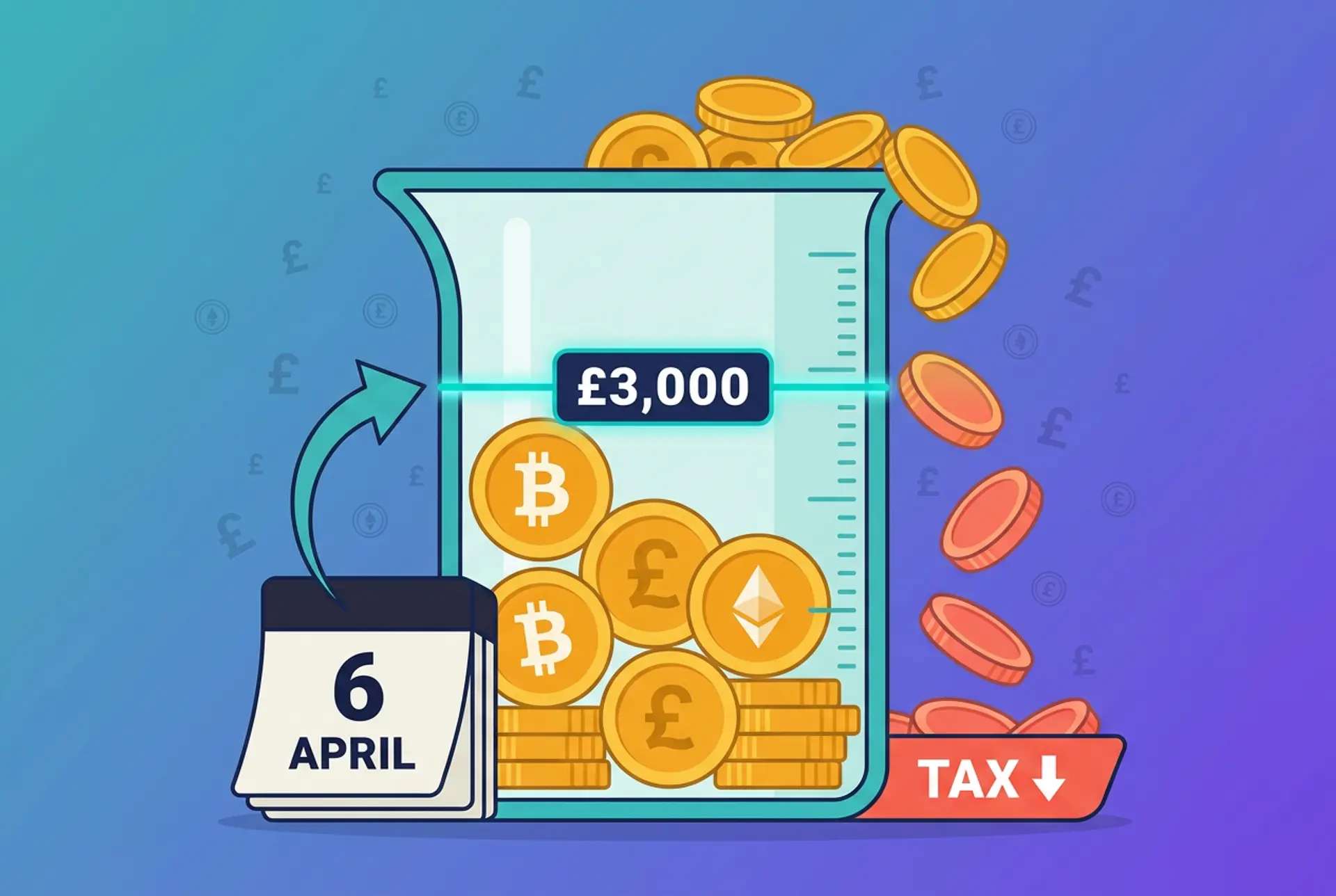
As an individual investor you can make £3,000 of capital gains in the 2026/27 tax year before you pay any capital gains tax.
The allowance is called the annual exempt amount, it covers gains from crypto together with gains from shares and other assets, and it resets every 6 April.
It cannot be carried forward, so any part of it you do not use is gone.
That one number answers the headline question, but it is rarely the whole story. Whether your swaps count towards it, what happens to your losses, and whether you still need to tell HMRC anything when you stay under it all matter just as much. This guide covers each of those, as at August 2026, along with the other allowances UK crypto investors can lean on. For the wider picture of how HMRC taxes crypto, our comprehensive UK crypto tax guide covers everything in one place.
Disclaimer
This guide is intended as a generic informative piece. This is not accounting or tax advice that can be relied upon for any UK individual's specific circumstances. Please speak to a qualified tax advisor about your specific circumstances before acting upon any of the information in this article.
What is the crypto tax-free allowance?
There is no allowance that exists only for crypto. What people call the crypto tax-free allowance is the capital gains tax annual exempt amount: the first slice of your total capital gains each tax year that is free of capital gains tax (CGT). For individuals it is £3,000 for 2026/27, the same as it was in 2025/26.
Three things about it catch crypto investors out:
- It covers all your chargeable assets together. Crypto, shares held outside an ISA, a second property: they all draw on the same £3,000. If you sold shares at a £2,000 gain this year, only £1,000 of allowance is left for your crypto.
- It is use it or lose it. The allowance resets on 6 April and any unused amount does not roll over.
- It is automatic. You do not claim it or apply for it; it is simply deducted when your tax is worked out.
The allowance used to shelter far more. It was £12,300 as recently as 2022/23, then £6,000 in 2023/24, and it has sat at £3,000 since April 2024. A few years ago a casual investor could reasonably assume their gains were covered. At £3,000, a handful of profitable swaps can use it up before you have withdrawn a single pound to your bank account.
| Tax year | Annual exempt amount |
|---|---|
| 2022/23 | £12,300 |
| 2023/24 | £6,000 |
| 2024/25 | £3,000 |
| 2025/26 | £3,000 |
| 2026/27 | £3,000 |
What counts towards the £3,000?
Capital gains, not sale proceeds and not income. You make a gain (or loss) whenever you dispose of crypto, and HMRC counts more than just cashing out as a disposal:
- selling crypto for pounds or any other currency
- swapping one crypto for another, for example ETH to SOL
- spending crypto on goods or services
- gifting crypto to anyone other than your spouse or civil partner
The gain on each disposal is broadly what you received minus what the asset cost you, worked out under HMRC's matching rules (same-day, then the 30-day rule, then the Section 104 pool, which averages your costs). Our guide to capital gains tax on crypto walks through the calculation in detail.
Just as important is what does not touch the allowance at all, because no disposal has happened or the disposal is relieved:
- buying crypto with pounds and holding it, however much it rises
- transferring crypto between your own wallets and exchanges, although any crypto used to pay a transfer or network fee may itself be a disposal
- gifting crypto to your spouse or civil partner, which is generally treated as no gain and no loss
- donating crypto to a registered charity, in most cases
Income from crypto is a different tax altogether. Staking rewards, mining income and some airdrops are subject to income tax, not CGT, so they never use up your £3,000. They have their own allowances, covered below.
How much tax do you pay once you go over it?
Only the gains above £3,000 are taxed. For disposals in 2026/27 the CGT rates on crypto are 18% and 24%: 18% applies to the part of your taxable gains that fits within your unused basic rate band, and 24% applies above it. For 2026/27 the basic rate limit is £37,700 of taxable income; for someone entitled to the full £12,570 personal allowance, that usually corresponds to £50,270 of gross income before gains are added. Larger gains can straddle the two rates.
Example: how the numbers fall out. Say your gains across the year come to £5,400, made up of a few profitable swaps and one sale to pounds. Deducting the £3,000 allowance leaves £2,400 taxable. On a £35,000 salary, the whole £2,400 sits within your remaining basic rate band, so the bill is £432 at 18%. On a £60,000 salary, the same gains cost £576 at 24%. Either way, the first £3,000 of profit was tax free.
A pattern we see a lot in Recap is the opposite surprise: someone assumes they are miles over the allowance because they traded heavily, but once costs are matched properly and losses are netted off, their taxable gain is under £3,000 and the bill is nil. The calculation, not the volume of trading, is what decides it.
Losses change how much of the allowance you actually use
Losses and the allowance interact in a way that surprises people, and the ordering matters:
- Same-year losses come off first, before the allowance. If you made £4,000 of gains and £2,500 of losses in 2026/27, your net gain is £1,500. That is below £3,000, so no tax, but notice the losses were used even though the allowance alone might have covered more of the gain. You cannot hold same-year losses back to use later. (Watch the reporting side of this example too: gains before losses were £4,000, which matters if you file Self Assessment, as covered in the next section.)
- Carried-forward losses are gentler. Losses claimed from earlier years only need to be used to bring your gains down to the allowance, not below it. The rest stay available for future years. The rules are set out in HMRC's guidance on CGT losses.
- Losses must be reported before you can use them. You normally have four years from the end of the tax year of the disposal to claim a loss, either on your return or in writing.
If you are sitting on assets worth less than you paid, tax loss harvesting explains how realising them can shelter gains, and where the matching rules limit it.
Under the allowance: do you still need to report anything?
Often no, but staying under £3,000 does not always mean staying silent. If you are registered for Self Assessment, you normally need to complete the Capital Gains Tax summary pages if any of these apply:
- your total disposal proceeds exceed £50,000. Proceeds means the total value of everything you disposed of, so an active trader recycling the same £5,000 can cross £50,000 of proceeds with barely any gain;
- your chargeable gains before deducting losses exceed £3,000. Losses can reduce your tax bill to nil without removing the reporting requirement. In the example above, £4,000 of gains cut to a £1,500 net gain by losses still needs the capital gains pages, because gains before losses crossed the £3,000 line; or
- you want to claim an allowable capital loss, or make another capital gains claim or election. Reporting a loss is how it becomes available to use, so if you are following the advice in the section above, that on its own means completing the capital gains pages, even when no tax is due.
Less-common triggers exist too, such as gains from an earlier year becoming taxable in the current one, so check the current SA108 notes if your position is unusual.
Separately, a notice to file from HMRC means you must submit the tax return, whatever the size of your gains. Whether you also complete the Capital Gains Tax summary pages depends on the triggers above.
If none of that applies and your gains are under the allowance, there is normally nothing to send HMRC for that year. Keep your records anyway; if a later year does need reporting, you will need cost history going back years. Our guide to the Self Assessment tax return for crypto covers what reporting looks like when it is needed.
The other allowances crypto investors can use
The £3,000 gets the attention, but two income tax allowances matter to most crypto users:
- The personal allowance: £12,570. Crypto income such as staking rewards is added to your other income for the year. If your total income is under the personal allowance, no income tax is due on it.
- The trading and miscellaneous income allowance: £1,000. Up to £1,000 of trading or miscellaneous income per year is tax free, and for many casual stakers this covers their rewards entirely. If you are under it and do not otherwise need to file, the income does not need declaring.
How the income side works, including when HMRC treats rewards as miscellaneous income rather than trading income, is covered in our guide to crypto income tax in the UK.
Using the allowance before 5 April
Because the allowance does not carry forward, the weeks before 5 April are when it is either used or wasted. Some investors deliberately realise gains up to the allowance each year, which raises the cost basis of their holdings without creating a tax bill. Two cautions before trying it:
- The matching rules can undo the plan. Sell and repurchase the same token on the same day or within the following 30 days and HMRC's same-day and bed and breakfast rules match the disposal to the repurchase rather than the older Section 104 pool. That can change or reduce the gain you intended to realise, so the strategy may not use the allowance as expected.
- A couple can cover up to £6,000. Transfers between spouses and civil partners are generally treated as no gain and no loss. If both partners still have their full £3,000 allowances available, a genuine and unconditional transfer before the eventual sale can allow both allowances to be used. Special rules can apply after separation.
There are more approaches, from timing disposals across tax years to donations, in our article on legal ways to reduce your UK crypto tax bill.
Can you hold crypto in an ISA or pension to avoid CGT?
Not through an ISA. Coins and tokens themselves are not qualifying ISA investments, so day-to-day crypto investing sits outside that wrapper and relies on the annual exempt amount instead. Pensions are less absolute: HMRC's pension tax rules do not impose a blanket ban on particular asset types, but what a scheme can actually hold depends on its own rules, its trustees or provider and other regulatory restrictions, and direct crypto is not generally available through mainstream retail pensions.
The picture around indirect exposure moved recently. The FCA lifted its retail ban on crypto exchange traded notes (cETNs) on 8 October 2025, and for a short window they could be bought inside a stocks and shares ISA. From 6 April 2026, new cETN purchases are only ISA-eligible inside an Innovative Finance ISA, although holdings bought into a stocks and shares ISA before that date can stay put, and registered pension schemes can also hold eligible cETNs subject to provider availability. In practice few platforms offer cETNs through an Innovative Finance ISA today, so this route remains narrow. Our piece on the FCA's move towards retail access for crypto ETNs has the background.
How Recap helps you stay inside the allowance
Working out whether you are under £3,000 means matching every disposal to its cost under the same-day, 30-day and Section 104 rules, across every exchange and wallet you use. That is exactly the calculation Recap automates: connect your accounts or upload your transaction data and Recap applies HMRC's share pooling rules for you, showing your capital gains position for the year and producing a downloadable Capital Gains Report when it is time to file. Data is end-to-end encrypted, so we never see your portfolio.
If you just want a quick estimate first, our free crypto tax calculator can estimate the gain and CGT on a single disposal. See where you stand with Recap before 5 April, while there is still time to do something about it.
What this means for you
- The crypto tax-free allowance is the CGT annual exempt amount: £3,000 for individuals in 2026/27, shared across all your chargeable assets, and it does not carry forward.
- Swaps, spending and gifts (except to your spouse or civil partner) all count towards it; holding, transfers between your own wallets (aside from any crypto used to pay fees), and transfers to a spouse or civil partner generally do not.
- Gains above £3,000 are taxed at 18% within your unused basic rate band and 24% above it.
- Same-year losses reduce gains before the allowance is applied; carried-forward losses only need to bring gains down to £3,000, and losses must be reported before you can use them.
- Staying under the allowance does not always mean nothing to report: for Self Assessment filers, proceeds over £50,000, gains before losses over £3,000 or a capital-loss claim still trigger the capital gains pages.
- Staking and other crypto income never uses the £3,000; it is covered by the personal allowance and the £1,000 trading and miscellaneous income allowance instead.
References
- HMRC, Capital Gains Tax: annual exempt amount
- HMRC, Capital Gains Tax rates
- HMRC, Capital Gains Tax: losses
- HMRC, Work out if you need to pay Capital Gains Tax
- HMRC, SA108 Capital Gains Tax summary notes for the 2025/26 return (published 2026)
- HMRC, Capital Gains Tax: gifts to your spouse, civil partner or charity
- HMRC, Tax-free allowances on property and trading income
- HMRC Cryptoassets Manual, CRYPTO22200: pooling
- HMRC Pensions Tax Manual, PTM121000: investments
- HMRC, Tax treatment of cryptoasset exchange traded notes
- FCA, Information for firms that offer crypto exchange traded notes