
Crypto staking has emerged as a popular method for investors to earn passive income by participating in blockchain networks. However, what many UK taxpayers may not realise is that staking comes with complicated tax implications.
In this article, we'll cover everything you need to know about how staking is taxed in the UK and provide insights on how our crypto tax calculator can help you navigate through the complexities of tax calculations related to staking activities.
Disclaimer
This guide is intended as a generic informative piece. This is not accounting or tax advice that can be relied upon for any UK individual’s specific circumstances. Please speak to a qualified tax advisor about your specific circumstances before acting upon any of the information in this article.
What is crypto staking?
Crypto staking involves contributing your cryptocurrency to a Proof of Stake (PoS) network. In return, you earn more assets from the network over time as a reward. Staking can also refer to locking away your tokens to generate yields.
PoS is an alternative to Proof of Work (PoW), addressing issues like energy use and scalability. By staking, you help secure the blockchain and create new tokens, earning rewards for supporting network operations. The process is crucial for networks like Ethereum (ETH), Cardano (ADA), and Solana (SOL), offering both passive income and contributing to network sustainability.
How do you stake crypto?
There are different methods of staking, reflecting user preferences. It's important to understand how your chosen staking method works as it can influence rewards, risks, and tax.
- Running a node: This involves setting up and maintaining a node on the blockchain network to validate transactions and create new blocks. For instance, Ethereum 2.0 allows individuals to run validator nodes for network security and rewards.
- Through DeFi protocols: Decentralised Finance (DeFi) platforms offer staking services through smart contracts, enabling users to lock up tokens and earn rewards. These protocols, such as Uniswap for liquidity pools or Aave for lending, often provide additional incentives or governance rights.
- Centralised staking: Some platforms like Binance and Coinbase offer staking services for various cryptocurrencies like Ethereum and Cardano, managing the staking process on behalf of users.
- Using a non-custodial wallet: Users can delegate staking power to a validator without transferring ownership of their tokens. This is done through non-custodial wallets like Trust Wallet or MetaMask.
How is crypto staking taxed in the UK?
Tax on crypto staking can be confusing, you need to consider tax on the staking reward and possibly also CGT on the tokens staked. The new HMRC DeFi guidance on lending and staking indicates that it is necessary to consider if the nature of the staking rewards is capital or income. We explore the tax outcome for both scenarios below, for help determining whether your rewards are capital or income in nature refer to our Technical UK crypto tax guide.
Crypto staking: income tax
HMRC confirms that where a proof of stake activity does not amount to a trade, income rewards received in exchange for staking tokens will be taxable as miscellaneous income, subject to income tax.
The sterling value of the reward tokens at the date they are receivable will be the value of the taxable miscellaneous income, with any allowable expenses reducing the amount chargeable.
Crypto staking: capital gains tax
Staking rewards
Where staking rewards are capital in nature, they are subject to capital gains tax. A capital gain is realised on the reward at the time of staking the tokens, based on its estimated present value. This is re-assessed based on the value of the reward when received (usually on exit).
Staking rewards as a financial trader
In exceptional circumstances, where the taxpayer is a ‘financial trader’ in cryptoassets, staking rewards may need to be filed as trading income rather than miscellaneous income or capital rewards.
Tokens locked up
If you lose beneficial ownership of the tokens locked up in the staking arrangement, there is a disposal of those tokens for CGT purposes at the date they are staked. This could result in a capital gain or a capital loss, depending on the market value of the tokens at the date they are staked vs their matched acquisition cost.
There is also a further CGT disposal when the tokens are removed from the staking arrangement. This will be a capital gain where the value of the tokens staked have increased in value whilst they were staked. There will be a capital loss if their value is reduced.
For more help understanding beneficial ownership and determining whether income tax or capital gains tax applies to your staking activity refer to our Technical UK crypto tax guide. As this is a very complex area we also highly recommend getting advice from a tax professional.
When you sell staking rewards are you subject to capital gains tax?
Similar to how you're subject to capital gains tax (CGT) when selling, trading, or spending a crypto asset you've been HODLing, disposing of your crypto staking rewards also triggers CGT. When you receive a staking reward, it's considered an acquisition of the asset for CGT purposes, with its sterling market value being your acquisition cost. Calculate any capital gains or losses as usual based on the market value when you sell them, applying HMRC's share matching and pooling rules.
Find out more about disposals and calculating capital gains in our UK crypto tax guide.
How to report crypto staking rewards on taxes
Crypto staking rewards need to be declared to HMRC. Include it on your annual Self Assessment Tax Return if you already file one. The nature of your staking rewards (capital or income) determines where they need to be reported on your return.
- If the rewards are more than £10,000 and are taxable as income, you will need to register with HMRC.
- If the income is less than £10,000 and you don’t otherwise need to file a return, call HMRC to declare it and they may agree to collect the tax via PAYE.
Tracking crypto staking taxes with Recap
Calculating crypto taxes, particularly staking rewards is complex and extremely time consuming. With Recap you can track your crypto portfolio and automatically generate a HMRC compliant tax report.
- Simply connect your exchange accounts or wallets through our automated integrations or enter your data manually via the user interface or CSV file.
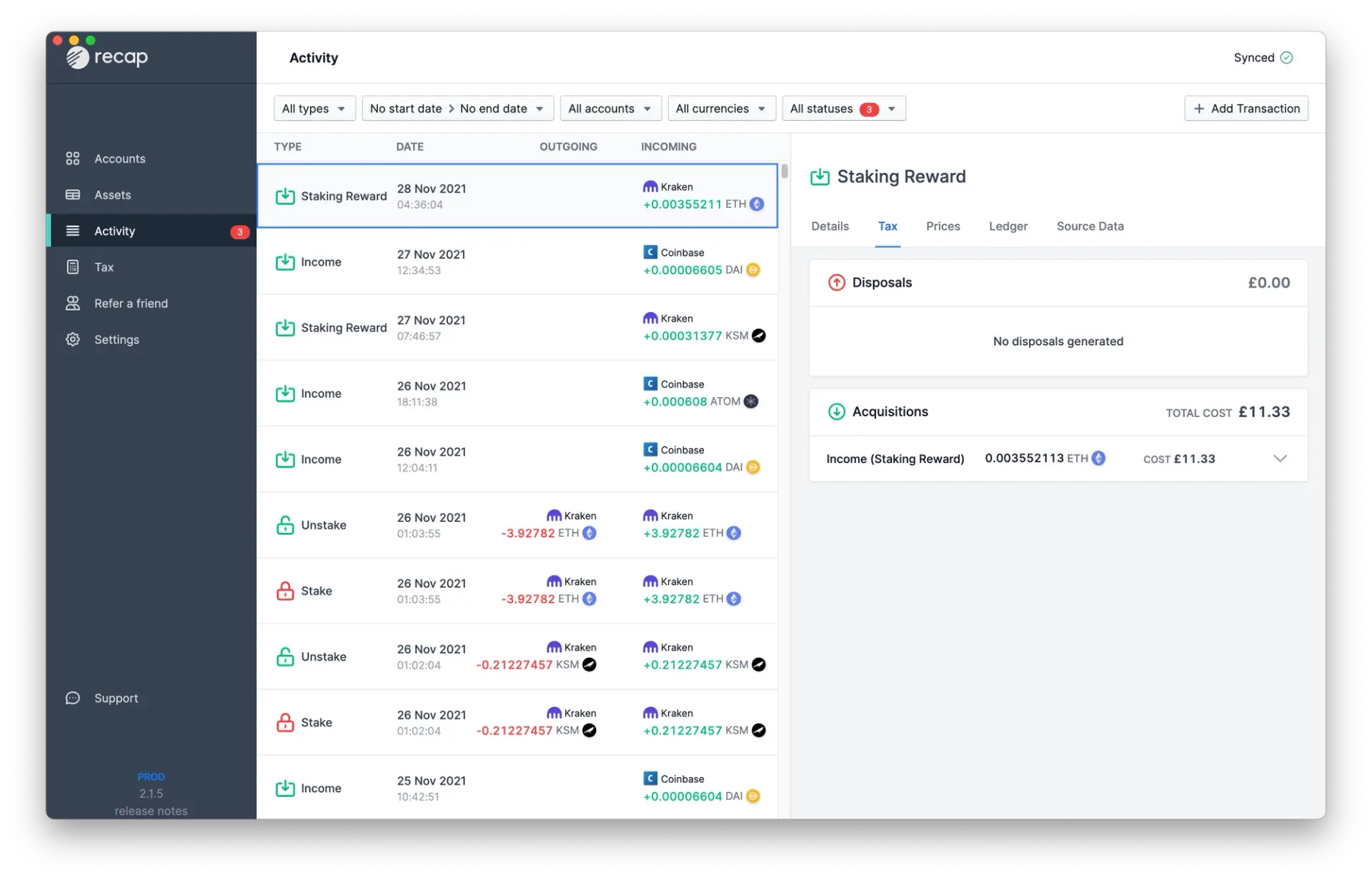
- Recap generates taxable events for each of your staking reward transactions, generating acquisition and income tax events based on the cryptoasset's GBP market value. (You can override this treatment if you decide they are capital rewards).
- Review your staking activity in Recap to check it agrees with the tax treatment you have decided upon. Depending on the metadata provided for the transaction, Recap may or may not be recognising a CGT disposal of the tokens locked up in the staking arrangement upon entry and exit.
- You can see the tax impact of every staking reward transaction (example below) in the Activity panel tax tab or download a PDF tax report when you are ready to file.
Hit the sign up button to start calculating your crypto taxes with Recap for free.