
Many UK tax professionals we meet with still believe crypto is a niche issue. Ironically, when we look at the numbers, the data tell a different story.
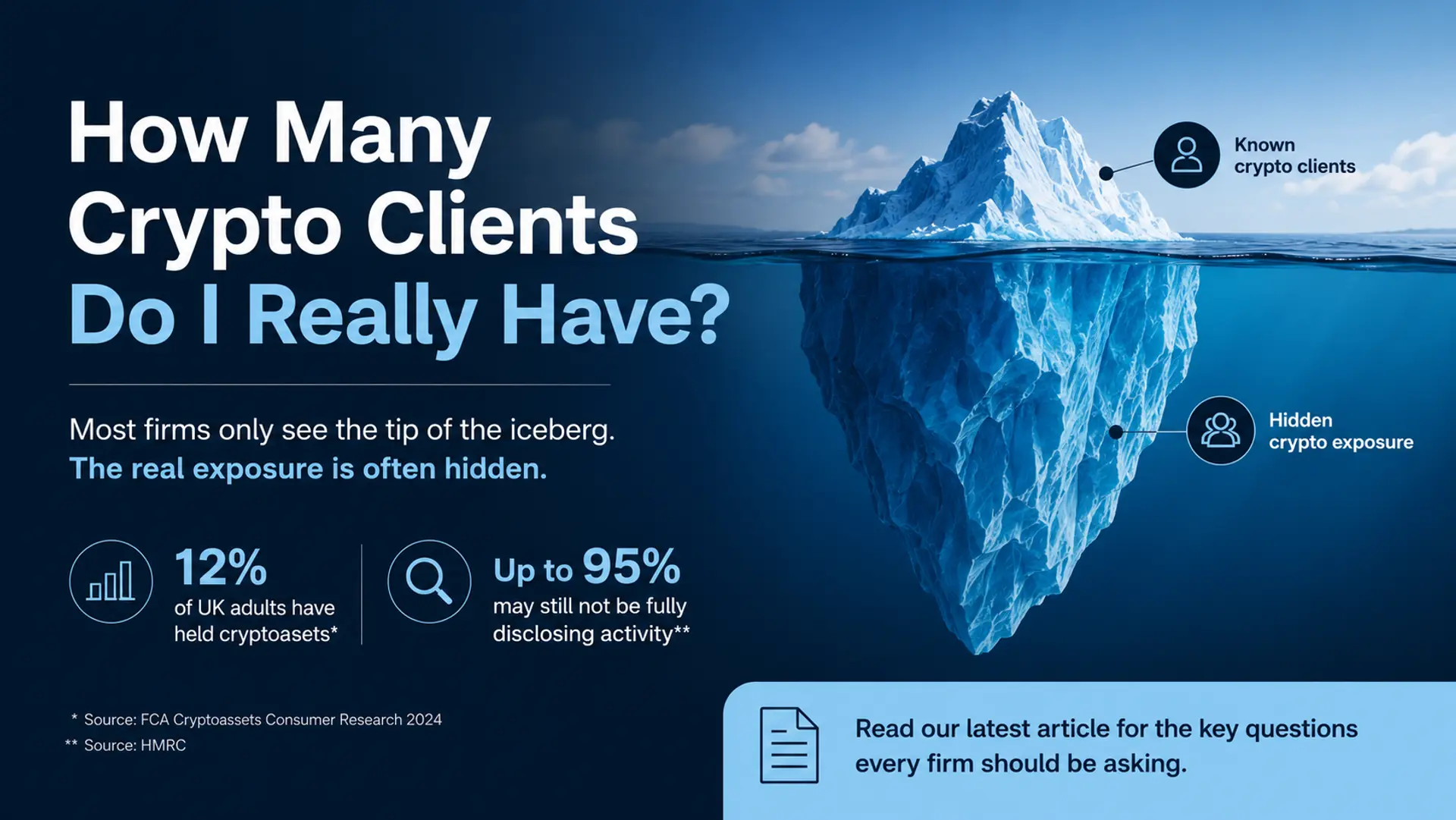
The FCA estimated a couple of years ago that around 12% of UK adults have held cryptoassets.
More recently, the Treasury has suggested that a very large proportion of crypto holders, potentially up to 95%, may still not be fully disclosing their crypto activity for tax purposes, or disclosing at all. Consequentially HMRC is redoubling its efforts to close the tax gap.
https://www.bbc.co.uk/news/articles/ckgl2je65klo
These two data points are important. Together they fully explain today’s dangerous misconception that many accounting and tax professionals understandably hold.
The maths
Let’s say you have 1,000 self-assessment clients. Your current belief is that you have a handful of crypto clients.
1,000 x 12% = 120
But if only 5% are disclosing…
120 x 5% = 6
So we see that crypto can present a major blind spot for firms.
Considering the data above, it explains the widespread view that no one has crypto clients. Whilst many practices believe they have only “a handful” of crypto clients, the reality often aligns with the overused analogy. i.e., those crypto clients you know about today are merely the tip of the… ahem.
Another stumbling block stems from the fact that most clients with digital assets do not think of themselves as “crypto investors” if they don’t conform to the crypto-bro stereotype.
Your clients may simply have:
- bought Bitcoin on Revolut
- opened a Coinbase account years ago
- received staking rewards
- traded meme coins
- used MetaMask occasionally
- experimented with NFTs during the last cycle
To clients, such exposure can feel informal or insignificant. To HMRC, however, it can create:
- Capital Gains Tax liabilities
- income tax exposure
- PAYE implications
- disclosure obligations
- detailed record-keeping requirements
Moreover, we find HMRC enquiries are becoming increasingly granular. In their letters, HMRC commonly ask, “When did your client’s cryptoasset activities begin?”
HMRC also request:
- exchange histories
- transaction exports
- staking activity
- airdrops and forks
- software calculations
- valuation methodology
- pooling calculations
- employment-related token information
Crypto tax calculations now need to be defensible. Plausible doesn’t cut it any more.
Once a firm has identified a crypto client, the most important question firms should ask now is, “When did your cryptoasset activities begin?”
This single question is extraordinarily powerful. Why? Because many clients:
- forget older wallets
- omit dormant exchange accounts
- ignore historic bull-market activity
- assume old transactions no longer matter
- overlook years that may still affect pooling calculations today
A client who says “I only traded crypto this year” may actually have:
- bought Bitcoin in 2020
- moved assets through multiple exchanges
- participated in staking
- received airdrops
- lost access to wallets
- or triggered taxable events years earlier
Without establishing the true start date of crypto activity, firms risk working from incomplete transaction histories and inaccurate tax positions.
Other Questions Firms Should Now Be Asking
The following checklist, based heavily on real HMRC enquiry requests, can dramatically improve crypto visibility across your client base.
- Have you previously disclosed your crypto activity to HMRC?
- Have you bought, sold, exchanged or held cryptoassets during the tax year?
- Which exchanges, apps or wallets have you used?
- Can you provide complete transaction histories from all platforms used?
- Have you transferred crypto between wallets or platforms?
- Have you received crypto through staking, mining, lending or yield farming?
- Have you received any airdrops, forks or promotional token rewards?
- Have you received tokens through employment, consulting or self-employment?
- Have you used crypto to purchase goods, services or property?
- Have you lost access to wallets, suffered hacks, or received compensation linked to cryptoassets?
- Have you used crypto tax software previously?
If so:
- Which software?
- Who prepared the calculations?
- Who checked these against HMRC rules?
- Were HMRC pooling rules applied accurately?
- Did it address the Capital Gains Tax split year at the time for 2024/25?
Data Privacy / Security is paramount:
Firms that ask “How important is data privacy to you in your crypto affairs?” will demonstrate understanding and empathy.
In a world that sees acts of identity theft, hacks, extortion and wrench attacks, this final question is becoming increasingly important. We find most, if not all, crypto holders are highly sensitive about:
- wallet visibility
- exchange data sharing
- offshore platform exposure
- personal security risks
Firms that demonstrate:
- secure handling processes
- privacy-conscious tooling
- controlled access to client data
will often achieve materially better disclosure and engagement, as well as bring a level of due comfort to their clients.
Final Thought
The biggest crypto risk facing many firms today is not technical capability. It is invisible exposure.
Because if 12% of the UK population has held crypto, there is a strong likelihood your client base already contains far more crypto activity than your firm currently sees. And like that old chestnut, the iceberg metaphor, the greatest risk is usually the part below the surface.