

Last month we asked for your help as we responded to HMRC's call for evidence on the taxation of decentralised finance involving the lending and staking of cryptoassets. It’s a hot topic, with a lot of shared concerns, so we had an idea of what to expect - but actually seeing the results on paper was pretty astonishing in places! Here’s the headlines with snippets of commentary from our response.
Around 150k UK DeFi users could be unaware that they are creating taxable disposals when lending and staking
Our survey found that the majority of UK DeFi lending and staking users (55.3%) are investing over £12,500. Additionally, a massive 53.7% of respondents were not aware that they were creating disposals (and changes of beneficial ownership) based on the new HMRC guidance.

HMRC’s uptake and understanding survey assumes 10% of adults own crypto in UK. With further investigation we can assume that there are at least 302k DeFi lending and staking users based in the UK. Combined with the results of our survey, this means that there could be around 150k DeFi lending and staking users in the UK who are completely unaware that they are creating taxable disposals.
Combined with market volatility, this brings many taxpayers into a position where their cryptoasset portfolio is worth less than their tax obligation, which is particularly punishing for the early adopters of the technology who may have entered when no guidance from HMRC existed.
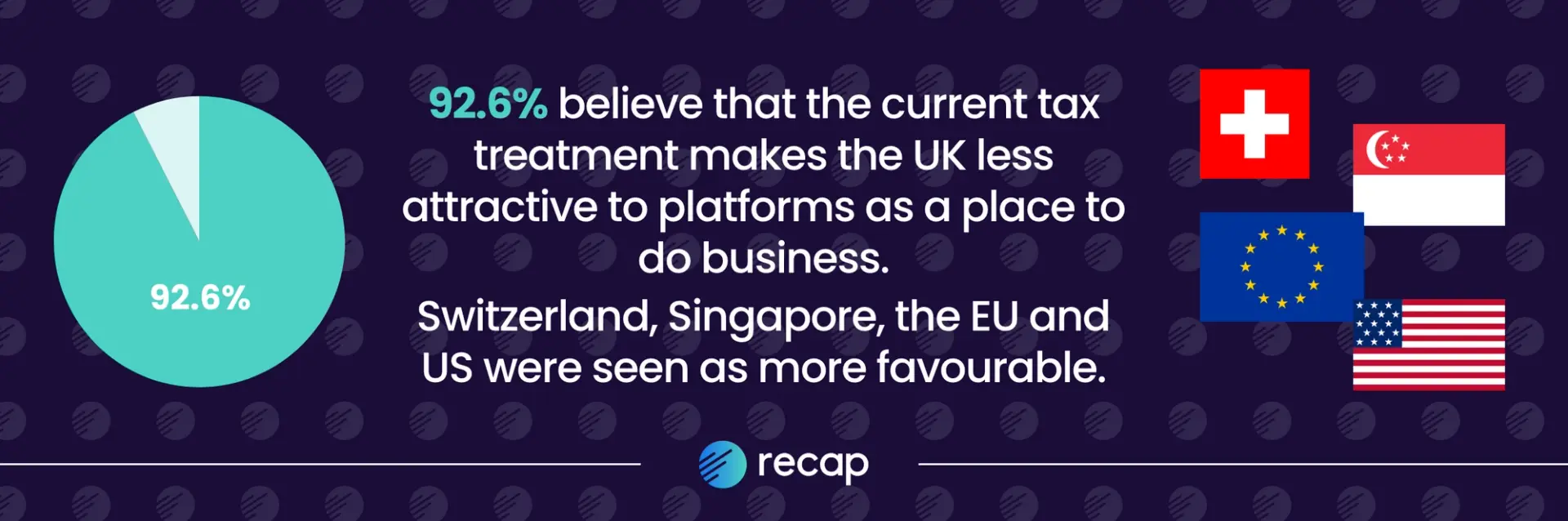
Does the current tax treatment make the UK less attractive to platforms as a place to do business?
92.6% of our survey respondents answered yes, with Switzerland, the US and EU emerging as jurisdictions where tax treatment was viewed as more favourable.
Platforms looking to operate in the UK market are acutely aware that offering lending and ‘staking’ services to UK consumers and businesses is not viable given the uncertainty of changes in beneficial ownership. There is often insufficient information available from each platform to consider the position and, if confirmed as a change of beneficial owner, this is not representative of the actual economic activity or the user's expectations.
Should a taxpayer invest in DeFi lending and staking activities that are capital in nature, they are further burdened by Marren v Ingles case law, penned 42 years ago, which insists that they must decide their expected return and pay tax on it upfront. This ageing case law drags virtually every DeFi lending and staking user into complex compliance requirements that are simply not representative of the economic activity.
So what would be better? The US legal system has the concept of ‘managed property’, where if all parties uphold the terms of the loan, the parties should not incur any taxes. This is contrary to the UK position, where tax disposals are created on entering or exiting a cryptoasset loan or staking position.
Our survey found that 31.6% of all Defi lending and staking activity from UK customers is with US companies, the largest cohort after decentralised platforms (67.1%). The US has the benefit of being a world-leading financial centre and early adopter of technology that has enabled the industry to flourish.
"If the UK wants to lead the way in crypto, the UK government needs to consider developing a cryptoasset tax regime focused on empowering wealth generation and removing compliance barriers that go above and beyond what other countries have to offer".
Dan Howitt, CEO Recap
82.1% are or will become less active or no longer participate in DeFi lending and staking because of new HMRC DeFi rules
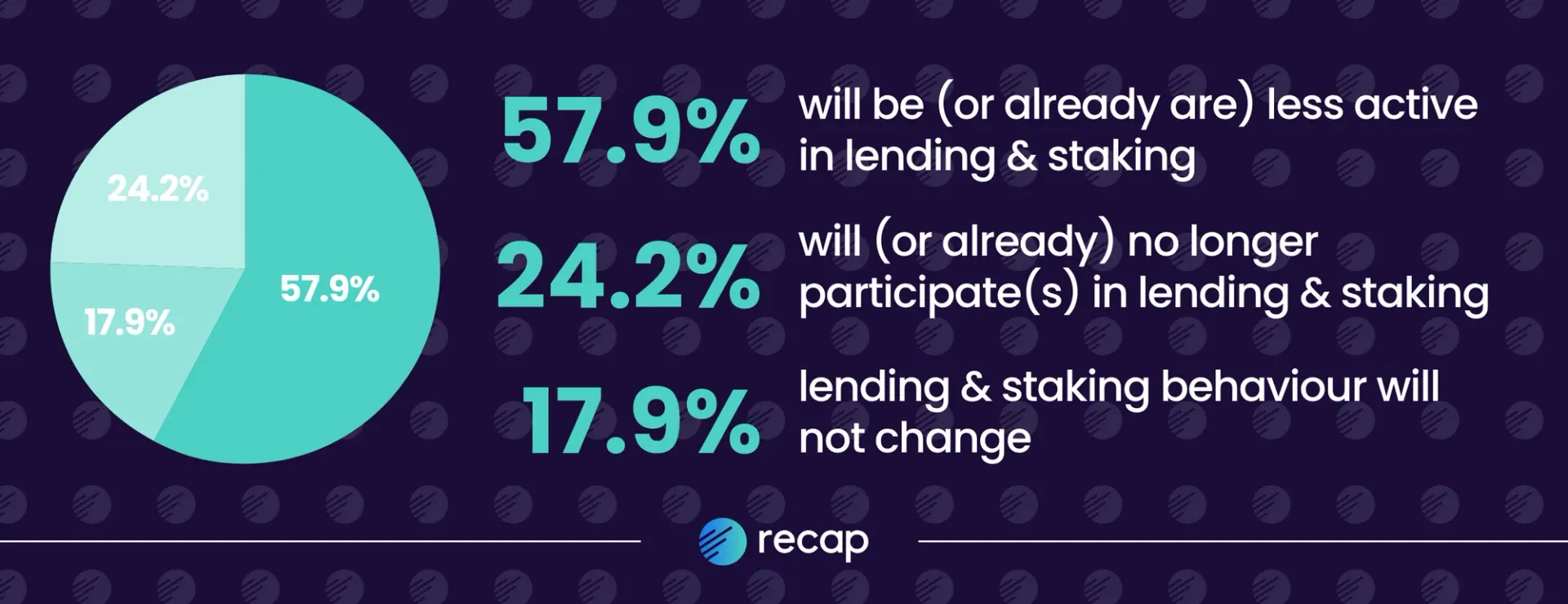
The majority (57.9%) of survey respondents stated that they are or will become less active as a result of HMRC rules and just under a quarter (24.2%) said that they (will) no longer participate.
Totally understandable, as currently under HMRC’s guidance, all DeFi lending and staking activity creates taxable events and with centralised DeFi lending and staking it’s hard not to assume beneficial ownership has passed when the platform takes absolute control of the cryptoassets.
Complexity of HMRC rules is a major concern shared by 96% of respondents
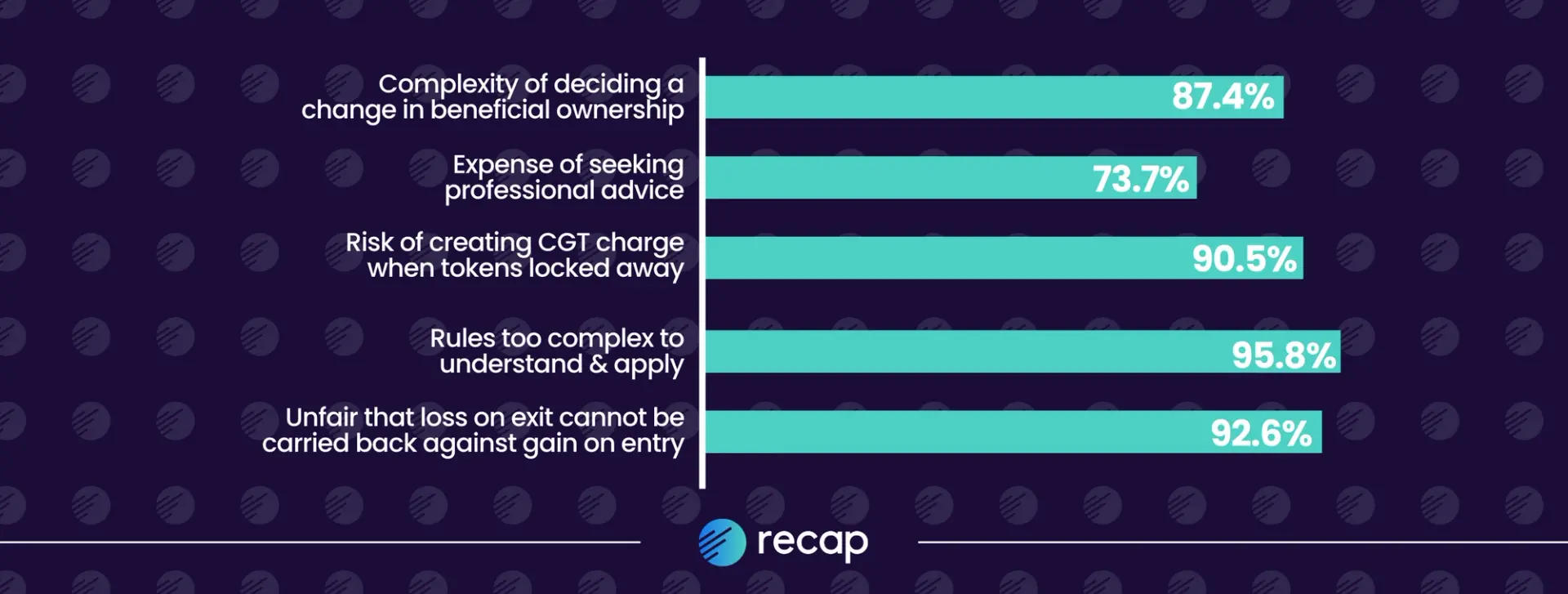
Many high areas for concern were expressed with “Rules being too complex to understand and apply” coming out on top. This makes sense considering that HMRC’s current Defi guidance and examples deem all interactions with decentralised platforms as a change in beneficial owner. Many investors do not have the expertise to assess if beneficial ownership has passed and the expense of seeking reliable advice is also an issue.
Many individuals may become insolvent with current DeFi rules
Given the volatility in the market and the lack of awareness that DeFi users are creating disposals, many individuals could become insolvent due to taxes on their DeFi lending and staking activities.
The tax approach is far removed from the taxpayer's expectations, and it feels like individuals are being penalised for participating in a new asset class. Those that have embraced the innovation first currently have the most to lose, having entered when no guidance was available. Recap would like to see consideration for early adopters, with any proposed changes to the rules being made retrospective.
We need to see changes to DeFi lending and staking tax rules!
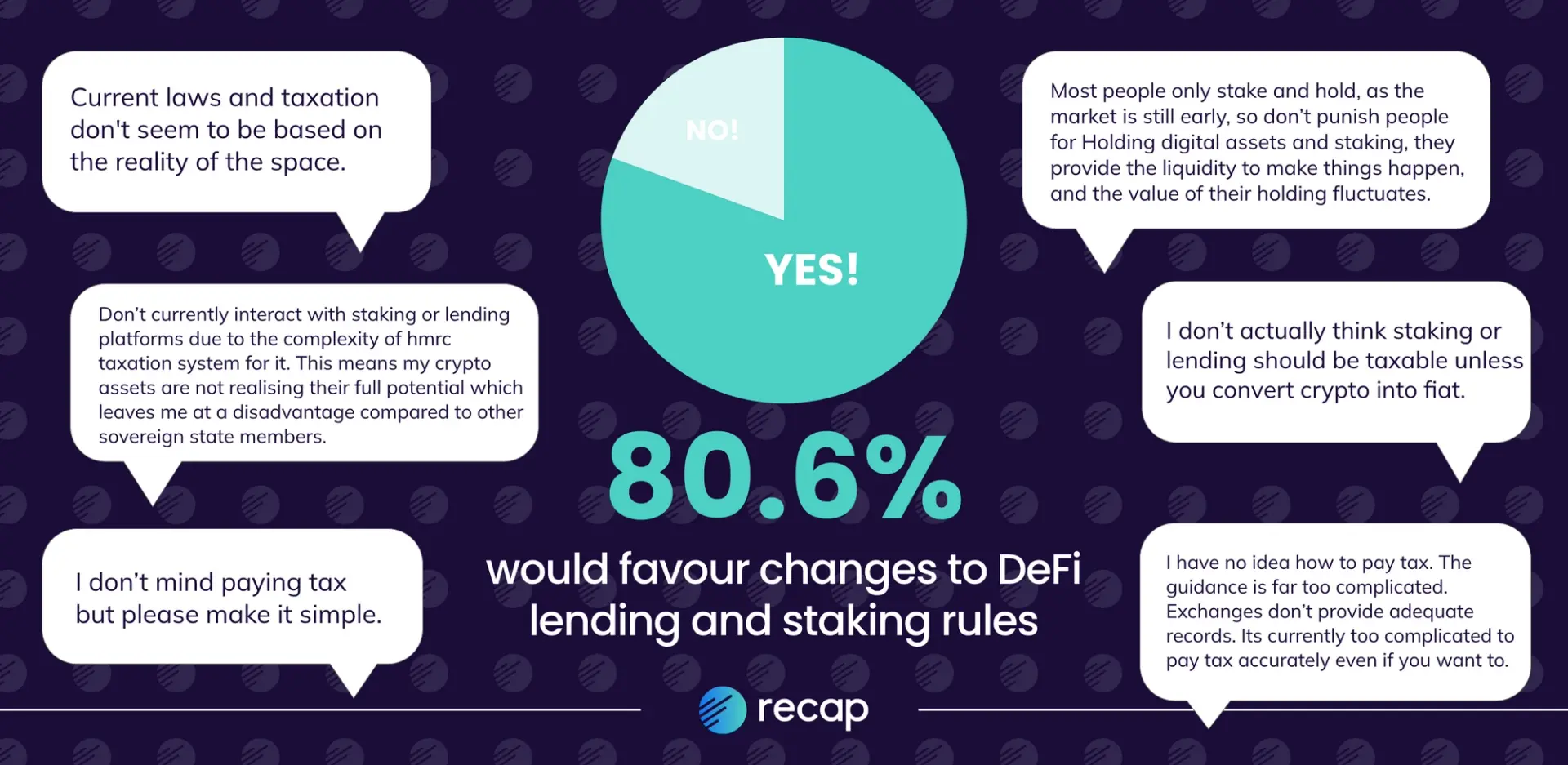
Our survey results speak for themselves!
What would we like to see?
We believe a no gain/ no loss option, would be the most suitable approach for the whole DeFi market. The government should at least consider that beneficial ownership has not passed where the user has engaged in DeFi activity that has a right to redeem the same or similar assets.
But for the UK to really succeed in becoming a thriving cryptoasset hub could we even go one step further? To align with the mechanics and nature of crypto transactions, thought should also be given to extending this option of no gain/ no loss to all crypto-to-crypto trades.
This would:
- simplify the compliance burden for crypto users - for every disposal it would only create a taxable gain/loss where fiat is involved, in all other cases ignored.
- increase and encourage tax compliance
- reduce administration in collection of taxes
- encourage investment and new wealth to the UK.
"The evidence presented in our response proves that there is need for change, not just because of the impact on individuals, but the whole UK economy. This call for evidence from HMRC shows willingness to change and is a step in the right direction. Right now we are far from a cryptoasset hub and at risk of falling behind other countries. HMRC must not stand shy of crypto, they should embrace the technology and must recognise that cryptoassets are a nuanced asset class where tax will not necessarily be aligned with other assets".
Dan Howitt, CEO Recap
In our opinion HMRC’s stance should be: do no harm - in respect of new and innovative technologies.