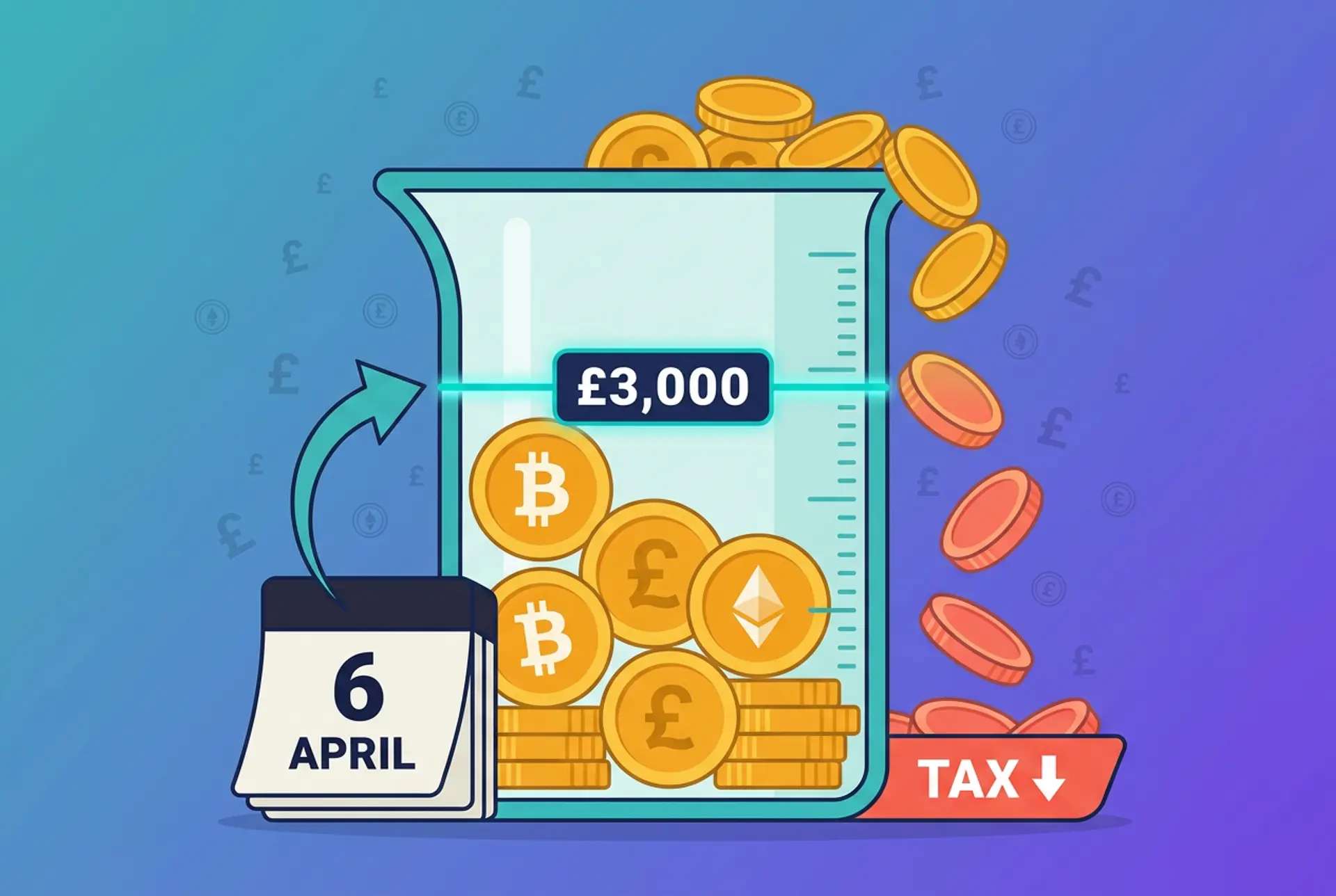

In May 2026, HMRC published qualitative research into how UK crypto investors and cryptoasset service providers (CASPs) actually interact with the tax system. Conducted by Ipsos through 53 in-depth interviews between October 2024 and January 2025, it is one of the clearest official windows we have into where crypto tax compliance is working, where it is breaking down, and what investors themselves say they need.
If you advise clients with crypto exposure, the findings are worth reading closely. They confirm a pattern many of us in the industry have observed for years: among active, higher-value investors, awareness of the principle of crypto tax is high, but the practical execution of getting a return right is genuinely difficult, and the tools and data standards underneath it have not caught up. That gap lands squarely on the desks of the accountants and advisers those investors turn to.
One important caveat before we get into it. This was qualitative research, built on 53 interviews and weighted heavily towards High Net Worth Individuals (HNWIs), 41 of the 45 investor interviews. HMRC is explicit that the findings are illustrative rather than statistically representative. So none of this is a national headcount. But the patterns will be recognisable to anyone who works in this space, and they line up closely with what we see day to day at Recap.
You can read the full report on GOV.UK: Qualitative research with cryptoasset investors and industry participants.
Here are the findings that matter most, and what we think they mean.
High awareness, low confidence in execution
Among the HNWIs interviewed, theoretical understanding of tax obligations was strong. They knew their disposals were liable for Capital Gains Tax, they knew there was an annual exempt threshold, and many noted that HMRC's guidance had become much clearer over the past decade, with the worked examples on GOV.UK singled out as particularly helpful.
Yet when it came to actually calculating what they owed, confidence dropped sharply. As one investor put it:
"Without the software, it would be next to impossible [to calculate tax], because it's such a convoluted process… It's not straightforward." — Investor (invests £300k to £400k)
The report identifies specific friction points. Investors making a high frequency of trades over short periods found calculating the profit on each individual trade extremely complex, with some considering it effectively impossible to do manually. The difficulty compounded when investors held many different cryptoassets, and when they had to account for the exchange rate of each asset at the precise moment of every purchase and sale, a rate that can move hourly.
The report also found genuine uncertainty around the tax treatment of specific activities. Investors named derivatives, yield farming, staking, and "cryptoassets acquired for free and then sold for a profit" as areas where they felt current guidance left them guessing. Several were unsure whether exchanging one cryptoasset for another was even a taxable event, and those who knew it could be found it hard to calculate. One investor captured the confusion well:
"I was doing this liquidity mining here, and lending and borrowing there… And I didn't know what came under Capital Gains and what came under income. Even on the [HMRC] website… it was unclear; it could be this, it could be that." — Investor (invests £500,000 or more)
The small number of non-HNWIs interviewed showed a different pattern: much lower awareness, with some unaware crypto was taxable at all and others assuming, often based on a vague memory of stocks and shares rules, that a high threshold meant it would never apply to them. HMRC notes that several of these investors did not know what the Annual Exempt Amount actually was.
The data quality problem is real
Investors who traded frequently leaned heavily on third-party tax software to work out their liabilities. They downloaded trading history from their exchange and fed it into a calculator, and they generally felt the cost was worthwhile because the alternative was unworkable.
But the research surfaced a consistent blocker. The calculators were not designed to read trading reports automatically, and every CASP produced its reports in a different format. Investors also reported that the outputs of tax calculators were inconsistent, which made populating a tax return harder. HMRC records this as a barrier to compliance in its own right.
This is where the research validates something Recap has been calling for over years: standardised, machine-readable exchange reporting. Any calculation engine, ours included, can only work from the data it is given. Good source data means statements or API access detailed enough for a tool to make a defensible determination on tax treatment, with the user able to override where needed. The harder problem the industry has to solve sits upstream, at the exchange, not in the calculator.
One point of precision, because it matters here. The research evidences inconsistent formats and difficulty importing; it does not say exchange data is incomplete. That incompleteness is something we see constantly in practice, missing transactions and gaps across wallets and exchanges, but it's our observation, not a finding of the report. We've tried to keep the two clearly separated throughout this post.
What the research does show is clear demand for better interoperability between exchanges and tax software, and for more consistent reporting from platforms. Without progress on the data side, even the best calculation engines will keep struggling.
How some tools hide the data problem instead of solving it
If incomplete data is the underlying issue, the worst thing a tool can do is paper over it. Yet that is, in effect, what some do, and this next point is our observation from running the product rather than a finding of the report.
Some crypto tax tools default to treating a transfer between a user's own wallets as a disposal at current market value. A routine move from an exchange to a personal wallet, economically a non-event, gets recorded as a sale. That quietly distorts the tax position: it can inflate an asset's cost base, which reduces or even eliminates gains that should have been taxable later. And because every movement is now treated as a disposal, missing transactions stop standing out. Nothing looks out of place, so the gaps become almost impossible to spot.
To a prospective customer, the result looks reassuring. The software has processed everything and produced a clean number, and the job looks done. In reality the user or their accountant is often left with the real work later: hunting down missing transactions, reconciling wallets and exchanges, and unpicking distortions the tool introduced.
The usual defence is that a market-value disposal is the "worst case," so the user can't lose out. We think that misses the point twice over. First, it isn't reliably the worst case at all: inflating an asset's cost base reduces the gain on the next disposal, so in many cases it understates tax later rather than overstating it. It's HMRC that loses out, not the user. Second, even where it does overstate an immediate bill, it does nothing to fix the data problem underneath. The gaps don't disappear; they just get buried under a tidy-looking calculation, and they tend to resurface, more expensively, when HMRC asks questions or an accountant has to stand behind the figures.
For the avoidance of doubt, this is not how Recap works. We treat a transfer between a user's own wallets as exactly that, a transfer, not a disposal. The benefit isn't just accuracy on that one movement; it's that the approach surfaces problems instead of hiding them. Because internal transfers aren't silently booked as sales, genuine taxable events stand out and can be reconciled properly: a deposit might be a purchase, the receipt of a gift, or an airdrop; a withdrawal might be a sale, a gift to someone else, or a payment for goods or services. Each is treated on its own terms. That reconciliation is where an accountant's or tax adviser's judgement adds real value, and the software's job is to make those decision points visible rather than paper over them.
What investors actually asked for: recognition, not just a calculator
The single most striking thing in the report, for our purposes, is that investors volunteered the solution themselves. In HMRC's words, investors "expressed a desire for HMRC-approved software to standardise taxable outputs" and "reported a desire for HMRC to approve or verify a tax calculator" so they could be assured they were declaring the right amount. Notably, this was echoed on the industry side too: the report records that CASPs suggested tax reporting could be simplified if HMRC supported a tax calculation software.
So the appetite is clearly there. The realistic question is what form it could take. Our view is simple: HMRC should publish a clear set of standards that crypto tax software must meet, and any provider that meets them could then describe itself as HMRC recognised. At a minimum, a workable standard might require a tool to demonstrate:
- correct Section 104 pooling;
- correct same-day and bed-and-breakfast matching (the 30-day rule for individuals, the 10-day rule for companies);
- transfers between a user's own wallets treated as transfers, not disposals;
- consistent, defensible fair-market valuations, including for assets not priced in sterling;
- a clear split between income and capital treatment for staking, lending, and other rewards;
- sensible handling of ambiguous or complex activity, such as DeFi and NFTs, with gaps flagged rather than hidden.
This stops short of HMRC approving or underwriting individual products, but it gives investors and accountants a signal they can actually trust.
These aren't abstract requirements; they are exactly the things an independent methodology review can test. When Andersen LLP reviewed Recap in March 2025, it checked the pooling and matching rules line by line, and noted that a number of calculators on the market don't account for the bed-and-breakfast anti-avoidance rules at all. That is precisely the kind of gap a published standard would expose: today it only comes to light when a firm voluntarily commissions a review, rather than being visible to every investor and accountant choosing a tool.
One thing such a standard should make explicit is what software can and can't do. Crypto tax software does not produce a finished tax position at the press of a button; it almost always needs manual reconciliation, often drawing on a tax adviser's experience, to reach the right answer. This is the flip side of the hiding problem above: a tool that appears to need no reconciliation usually isn't doing less work, it's concealing it. The point is sharpest for on-chain and DeFi activity, where the nature of a transaction is often ambiguous, whereas centralised exchanges tend to be more explicit and easier to determine. Saying this clearly, with HMRC's voice behind it, would protect investors as much as any recognition mark.
The reason this matters is that it raises the floor. Today there is no quality gate at all. Providers can market themselves as "HMRC compliant" or "suitable for UK investors" with no independent check on whether they apply those core mechanics correctly. Recognition wouldn't pick winners; it would simply give investors, accountants, and HMRC a way to tell which tools have been held to a credible methodology and which have not. That, we think, is the pragmatic and responsible path, and it is the one the industry should be arguing for.
The accountant referral gap
This connects to a structural quirk the research hints at. Investors told HMRC they mostly use their general accountants for crypto, that those accountants' crypto knowledge, while improving, was often limited, and that specialist crypto accountants remain uncommon.
Here is what we see on top of that finding. When a client brings a stocks-and-shares problem to an accountancy firm, the firm will typically take the statement, calculate the CGT position end to end, and file it. When the same client brings a crypto problem, the pattern often flips: the client is sent away to "find a crypto tax calculator" and do much of the work themselves. The firm re-enters the process near the end.
There's nothing wrong with software doing the heavy lifting; that is what it is for. The problem is the referral itself is usually unguided. With no recognised-status signal to point to, an accountant making a referral has nothing reliable to anchor it to, and little basis for due diligence on whether a given tool is methodologically sound. So clients can be routed, in good faith, towards tools that may not handle UK rules correctly. This is precisely the gap a lighter-touch recognition framework would help close: it would give accountants, advisers, and HMRC a defensible basis for pointing clients somewhere accurate.
Independent validation, in the meantime
While there is no formal recognition framework today, independent scrutiny of methodology is the closest available proxy, and it is why we have sought it out. In March 2025, Andersen LLP reviewed Recap's methodology against UK legislation. The review confirmed that Recap correctly applies Section 104 pooling, same-day matching, and the bed-and-breakfast rules (the 30-day rule for individuals and the 10-day rule for companies), with worked examples tested against each scenario. It also examined Recap's data-integrity checks and its multi-source valuation approach, drawing on institutional-grade pricing data, and concluded that accountants and advisers can rely on the platform's outputs and HMRC-aligned methodology.
Read the Andersen LLP review →
Beyond external review, assurance is built into the product itself. Recap gives users clear, transparent explanations of how each part of their tax position is determined, backed by several UK-specific integrity checks that actively verify a cost base has been calculated correctly. One such check reconciles Section 104 pool balances against the total quantity of tokens held across all wallets and exchanges, and flags any significant mismatch for review. This is the opposite of the "looks done" approach described earlier: instead of letting a data gap hide behind a clean-looking number, Recap brings it to the surface so it can be resolved before anyone has to stand behind the figures.
What this means for the industry
HMRC's research paints a clear picture. Among active, higher-value UK investors, awareness of crypto tax obligations is widespread and the willingness to comply is real. What's missing is infrastructure: consistent data from platforms, and tools investors and their advisers can trust without reservation.
With CARF reporting obligations beginning on 1 January 2026 and HMRC's focus on crypto compliance sharpening, the distance between a calculation that looks complete and one that is actually correct is going to matter more, and cost more, for everyone involved.
Better data standards from platforms, and a credible, lighter-touch way to recognise tools that meet a real methodological bar, are no longer nice-to-haves. They are becoming essential plumbing for a maturing market, and on the evidence of this research, they are exactly what investors are asking for.
For accountants and advisers
If your firm handles clients with crypto exposure, you're at the sharp end of this gap. Until a recognised standard exists, the burden of judging whether a tool is methodologically sound sits with you, and most firms have neither the time nor the specialist knowledge to audit a calculator's pooling logic before making a referral.
That's the gap we built Recap to close. The product is designed around UK rules, has been independently reviewed by Andersen LLP, and surfaces data-quality issues rather than burying them, so the figures you sign off on are ones you can stand behind. We work directly with accountancy firms, from one-off client cases to full partner arrangements, and we're always happy to talk through how a firm can make crypto referrals with the same confidence it already applies to stocks and shares.
If that's relevant to your practice, get in touch or take a look at the Andersen LLP review.