
Key takeaways
Yes, indirectly, and the yield is where the tax hides. SwissBorg is a Swiss-founded crypto wealth app, and it is not an offshore exchange trying to stay out of view.
Its users, including those in the UK, are now served by BlockNodes SAS, a French provider authorised as a Crypto-Asset Service Provider (CASP) under MiCA, and its UK financial promotions are approved by an FCA-authorised firm, so it sits inside the regulated system rather than around it.
From 1 January 2026 the Cryptoasset Reporting Framework (CARF) begins bringing in-scope crypto providers into automatic reporting to HMRC. The catch with SwissBorg is the way people use it.
It feels like a savings account, but the payouts from SwissBorg Earn are generally income for tax, and every swap you make in the app is a disposal for capital gains tax.
If you have used SwissBorg and not declared that income and those gains, now is the time to sort it out.
This guide covers what HMRC can realistically see, where SwissBorg stands with UK and EU regulators, why its yield and in-app trading trip people up at tax time, and the steps to take if you are behind. It reflects HMRC, FCA, AMF and OECD positions, and SwissBorg's published product and regulatory information, as of September 2026.
Disclaimer
This guide is intended as a generic informative piece. This is not accounting or tax advice that can be relied upon for any UK individual's specific circumstances. Please speak to a qualified tax advisor about your specific circumstances before acting upon any of the information in this article.
SwissBorg is one of the European providers in our guide to which crypto exchanges report to HMRC, which shows how its route to HMRC differs from a UK-registered exchange.
Why SwissBorg is easy to get wrong at tax time
Most exchange tax guides start with buying and selling. SwissBorg needs a different starting point, because the feature people use most is the one that quietly creates the most tax to track.
First, the yield is income. SwissBorg Earn (formerly Smart Yield) spreads your crypto across vetted protocols and pays you a return. Those payouts are generally taxed as income at their value on the day you receive them, in the same way interest or rewards are. They arrive as a steady drip across many tokens, they are easy to leave sitting in the app, and because Earn frames them like a savings return, plenty of people never think of them as a taxable event at all.
Second, every in-app swap is a disposal. SwissBorg's instant exchange makes switching one token for another feel like moving money between pots. For tax it is not: swapping one crypto asset for another is a disposal of the first, so a capital gain or loss is crystallised each time, even though no pounds leave your account.
Third, there was a token migration to account for. If you held the old CHSB token, SwissBorg migrated it to the new BORG token from October 2023 at a one-for-one ratio. A straight one-for-one token migration like this is not the same as cashing out. Provided the migration was a like-for-like token replacement and you did not receive any additional value, your original cost simply carries across to the new token, so it is worth making sure your records reflect that rather than losing the CHSB cost history.
Put those three together and a SwissBorg account that felt passive can hold dozens of income events and disposals that never involved a single withdrawal to your bank.
Does SwissBorg share data with HMRC?
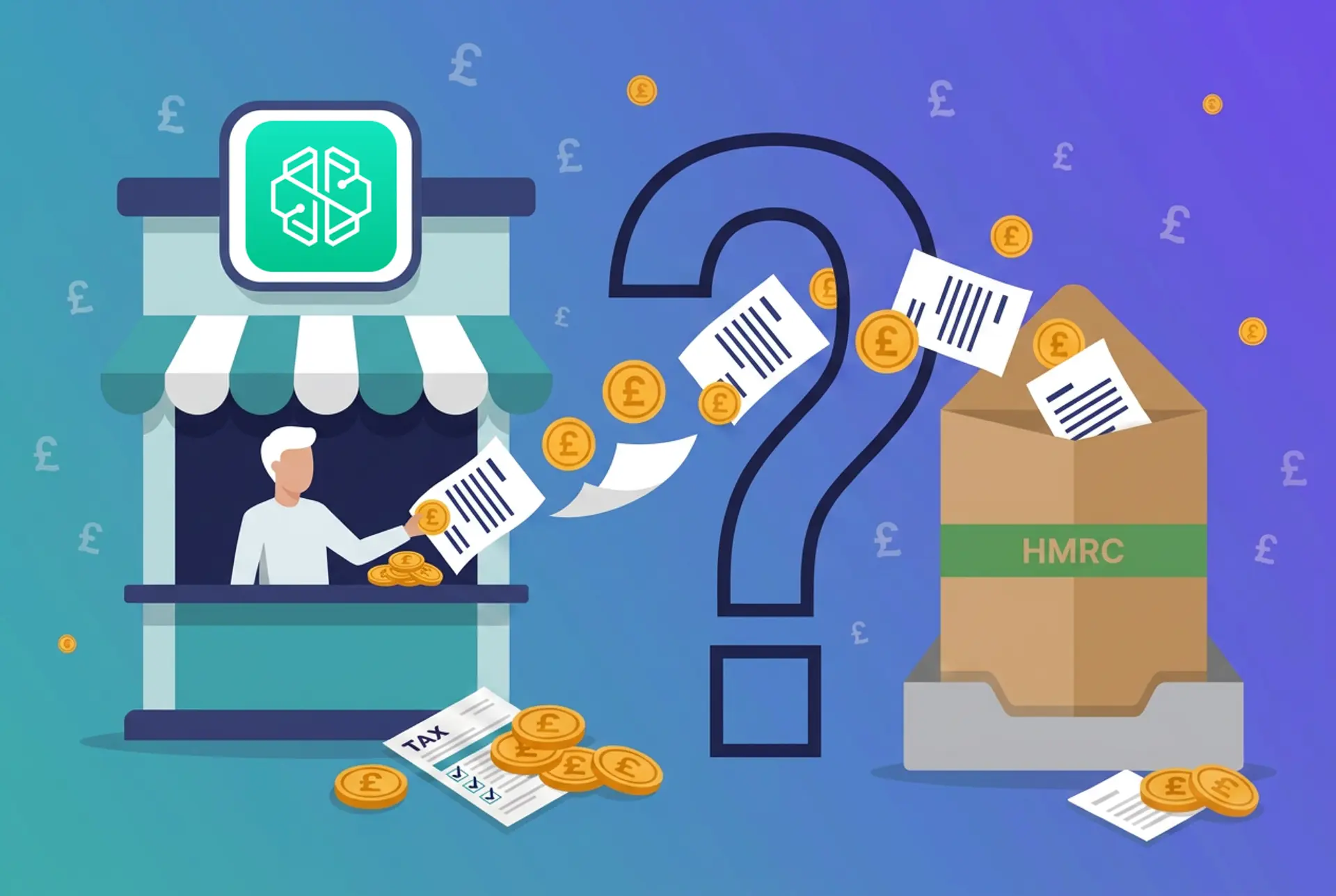
SwissBorg does not send HMRC a routine feed of its UK customers today, and there is no public record of a blanket customer-data handover. But it is not an offshore venue holding UK users at arm's length either. Its European operation is a regulated provider, it runs its UK marketing through the UK's financial-promotion rules, and it applies UK-specific onboarding controls. That is the profile of a business operating inside the system, not hiding from it.
Even without a voluntary feed, HMRC has ways in. Its information powers, under Schedule 23 of the Finance Act 2011 and Schedule 36 of the Finance Act 2008, let it compel a business to hand over records, and it has turned them on the crypto sector before: in 2020 Coinbase notified its UK customers that it was passing their details to HMRC, covering 2019/20 accounts that received more than £5,000 of crypto. There is also the practical point that money going into or out of SwissBorg usually crosses a UK bank or another exchange, and those on and off ramps are a further place the activity surfaces.
So the honest read is that SwissBorg is unlikely to be filing you to HMRC automatically today, but a regulated European provider leaves a clear trail, and that trail is getting easier for HMRC to follow, not harder.
What changes from 1 January 2026: the Cryptoasset Reporting Framework
CARF is the OECD's answer to a simple problem: crypto has been far easier to keep out of a tax authority's sight than a bank account. It sets up automatic data sharing between countries, the same way bank-account information has crossed borders for years. The UK brought it into law as The Reporting Cryptoasset Service Providers (Due Diligence and Reporting Requirements) Regulations 2025, effective 1 January 2026, and our explainer on the OECD's CARF release goes into the detail.
SwissBorg is a useful illustration of how CARF reaches across borders. Its European arm is a regulated crypto-asset service provider, so where it falls within the applicable reporting regime it will have reporting duties in its home jurisdiction, and CARF is built so that a report filed with one country's authority is passed on to the others. A UK resident using a European provider is exactly the situation the framework is designed for: your details may be exchanged with HMRC through CARF where the provider falls within the reporting regime. Whether the data reaches HMRC through direct reporting or through that international exchange, the direction of travel is the same.
What information is reported under CARF?
When a provider falls in scope, CARF sets a fixed list of details it must collect on every UK-resident customer, split between who you are and what you did.
Identity data covers your full name, date of birth, home address, country of tax residence, and your National Insurance number or Unique Taxpayer Reference. Transaction data covers the types of transaction you made, such as exchanges, transfers and spending, the annual aggregate value, and the units and type of each asset.
Each report goes to the provider's home tax authority first and is then passed to the other CARF members, which is the chain that carries a UK resident's details to HMRC. Under HMRC's CARF guidance, the rules carry penalties for users and providers alike: a user who deliberately or carelessly fails to provide a valid self-certification can face a penalty of up to £300, while reporting providers face separate penalties for due-diligence, reporting, notification, registration and record-keeping failures.
When does CARF reporting take effect?
Data collection begins on 1 January 2026 for in-scope providers with UK customers. The first reports are due to HMRC by 31 May 2027, covering the 2026 calendar year, and international exchange of CARF data between countries begins from 2027.
The practical takeaway is that your 2026 SwissBorg activity, including the Earn income and any in-app swaps you make this year, sits inside the first reporting period. The time to get your records straight is now, before that first exchange of data.
Is SwissBorg regulated in the UK?
This needs a little care, because SwissBorg's regulatory picture spans three places. It was founded in Switzerland and built its name as a wealth app. Its business is now authorised as a Crypto-Asset Service Provider (CASP) under the EU's Markets in Crypto-Assets regime (MiCA): that authorisation sits with BlockNodes SAS, a French entity authorised by the Autorité des marchés financiers, and SwissBorg migrated its users, including those in the UK, to that regulated entity during 2026.
The UK sits outside that EU regime. SwissBorg is available to UK users, but it is not on the FCA's cryptoasset register, and it does not claim to be. Instead its UK marketing is lawfully promoted through Gateway 21, an FCA-authorised firm that approves financial promotions under Section 21 of the Financial Services and Markets Act. SwissBorg also applies a 24-hour cooling-off period for new UK users, reflecting the FCA's financial-promotion rules for crypto. Being promoted through an FCA-authorised approver is not the same as being FCA-registered, and crypto held on the app is not covered by the Financial Services Compensation Scheme. None of that changes your tax position: while you can use SwissBorg, your income and gains from it are taxable, and they remain reportable to HMRC.
How is SwissBorg Earn taxed in the UK?
For crypto held on SwissBorg, UK tax follows the usual two tracks, and the yield features put more into the income track than most apps do.
The payouts from SwissBorg Earn are generally income, taxed at their sterling value on the day you receive each one. Selling crypto for pounds, or swapping one token for another in the app, is a disposal for capital gains tax, worked out through HMRC's Section 104 pooling rules, which our comprehensive UK crypto tax guide sets out in full. If you later sell tokens you first received as yield, you have a second, separate calculation: a capital gain or loss measured from the value you were already taxed on as income.
Example: Priya's Earn year. Priya keeps some of her ETH in SwissBorg Earn. Over the year she receives yield payouts worth £600 in total at the dates they landed, so that £600 is income and goes on her Self Assessment as such. Separately, she uses the in-app exchange to swap Bitcoin she had bought for £2,000 into another token when the Bitcoin is worth £6,000. That swap is a disposal: a £4,000 gain, of which £1,000 is taxable after the current £3,000 annual exempt amount. She never withdrew a penny to her bank, yet she has both income and a capital gain to report. For a quick estimate on a single disposal like the swap, our free crypto tax calculator does the sums.
Why has HMRC been sending nudge letters about crypto?
A nudge letter tends to land when the information HMRC holds does not line up with what you have declared. It is not a formal investigation, more a nudge to look again at your tax affairs and fix anything missing, and it usually notes that HMRC has information pointing to undeclared crypto.
HMRC has scaled these up quickly, sending 64,982 crypto nudge letters in 2024/25 against 27,713 the year before, roughly 134% more, on figures brought out by a Freedom of Information request by accountancy firm UHY Hacker Young. Data matching drives these campaigns, and the pool feeding them grows as CARF reporting begins. Undeclared yield income is a natural mismatch for this kind of exercise, because it is money received that never reached a tax return. Our guide on what to do if you receive an HMRC nudge letter about your crypto walks through the options.
What should I do if I have undeclared SwissBorg gains or income?
If you have used SwissBorg and not declared your income or gains, it is worth acting sooner rather than later. A voluntary disclosure is treated far more gently than something HMRC uncovers on its own.
First, get your records together. Export your full SwissBorg transaction statement, or connect it to tax software, so you have a complete history: every Earn payout, every in-app swap, and your deposits and withdrawals. Second, work out what you owe: treat the yield payouts as income from crypto at their value on receipt, and apply HMRC's Section 104 pooling rules to your disposals, including in-app swaps. Third, tell HMRC and pay. For a tax year that is still open, amend your Self Assessment return online; you have 12 months after the filing deadline, so a return filed by 31 January 2026 can be amended until 31 January 2027. For years that have already closed, use the Cryptoasset Disclosure Facility, open since November 2023. Interest runs on late tax and a penalty is common, but the penalty is lower when you come forward first, and if your history is complicated you can find a Recap-verified UK crypto tax specialist on our directory.
How Recap helps with SwissBorg tax
SwissBorg's mix of yield income and in-app swaps is precisely the kind of history that is painful to rebuild by hand, and that is where Recap comes in. You export your SwissBorg statement and import it into Recap, and Recap reads your trades, deposits, withdrawals and every Earn payout, values each one, and separates what is income from what is a capital gain under HMRC's rules. You can see the setup on our SwissBorg integration page.
Connect your SwissBorg account to Recap and turn a year of yield payouts and in-app swaps into one clear set of UK income and gains figures, saved as a report you can file yourself or hand to your accountant.
References
- HMRC and OECD: Cryptoasset Reporting Framework, domestic reporting of UK-resident cryptoasset users
- HMRC: Implementation of the Cryptoasset Reporting Framework (penalties for users and reporting providers)
- The Reporting Cryptoasset Service Providers (Due Diligence and Reporting Requirements) Regulations 2025
- Schedule 23, Finance Act 2011
- Schedule 36, Finance Act 2008
- HMRC Cryptoasset Disclosure Facility
- Nudge-letter statistics: UHY Hacker Young Freedom of Information request, October 2025
- SwissBorg UK financial promotions (Gateway 21, Section 21 approval)
- SwissBorg 24-hour mandatory waiting period (UK only)
- SwissBorg MiCA authorisation via BlockNodes SAS (French AMF)
- SwissBorg CHSB to BORG token migration
- Coinbase 2020 notification to UK customers (2019/20 accounts over £5,000 of crypto)