
Key takeaways
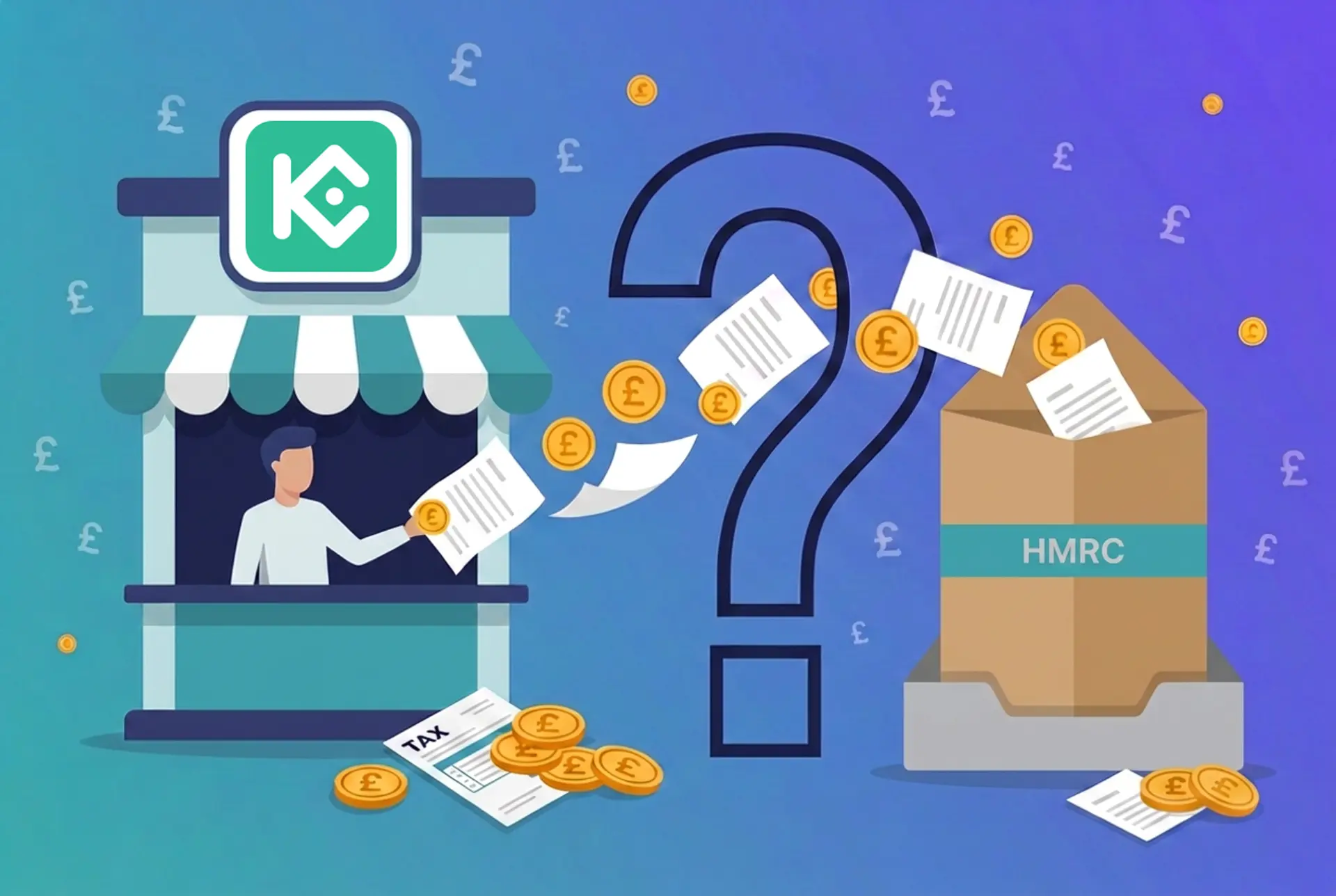
Indirectly, yes. KuCoin is an offshore exchange. It is not registered with the FCA, it sits on the FCA's warning list, and it is not a UK-based reporting provider, so it does not hand UK customer data to HMRC automatically. But that is not the reassurance it sounds like.
HMRC has long-standing powers to obtain exchange data, and from 1 January 2026 the Cryptoasset Reporting Framework (CARF) widens international data sharing to cover UK residents using overseas platforms.
KuCoin's own recent history underlines the direction of travel: in January 2025 its operating company pleaded guilty to running an unlicensed money-transmitting business in the US, with weak anti-money-laundering controls, and agreed to pay nearly 300 million dollars.
If you have traded on KuCoin and not declared the gains or income, it is worth getting on top of it now.
Below: what HMRC can realistically get hold of, where KuCoin sits with regulators, why a KuCoin account is so awkward to reconcile, and what to do if you owe tax. It reflects HMRC, FCA and OECD positions as of June 2026.
Disclaimer
This guide is intended as a generic informative piece. This is not accounting or tax advice that can be relied upon for any UK individual's specific circumstances. Please speak to a qualified tax advisor about your specific circumstances before acting upon any of the information in this article.
KuCoin is one of the offshore venues in our comparison of which crypto exchanges report to HMRC, which explains how each group of platforms reaches HMRC.
Does KuCoin share data with HMRC?
KuCoin runs from offshore and is not on the FCA's cryptoasset register, so there are no routine UK-customer reports flowing from it to HMRC, and nothing like the bulk handover Coinbase made in 2020 has been reported. Taken at face value, that looks like breathing room.
It is less than it seems. Two of HMRC's information powers, Schedule 23 of the Finance Act 2011 and Schedule 36 of the Finance Act 2008, let it demand customer data from businesses, and your money almost always touches the regulated system on the way in or out, through a UK bank or a UK-registered exchange, which is where a trail starts. KuCoin's own recent history shows offshore is no shield. In January 2025 its operating company admitted US charges of running an unlicensed money-transmitting business with weak anti-money-laundering controls, paying roughly 297 million dollars, leaving the US market for two years, and removing its founders from management.
The realistic read, then, is that KuCoin is probably not reporting you to HMRC right now, but your footprints are there to be followed, and the reporting regime is closing in.
What changes from 1 January 2026: the Cryptoasset Reporting Framework
The Cryptoasset Reporting Framework, CARF, is how the OECD intends to make crypto as visible to tax authorities as bank balances already are, through automatic annual reporting between countries. It became UK law via The Reporting Cryptoasset Service Providers (Due Diligence and Reporting Requirements) Regulations 2025, live from 1 January 2026, and our explainer on the OECD's CARF release walks through it.
The crucial feature for an offshore exchange is that CARF is international. Many jurisdictions have signed up to collect crypto data and swap it with each other, so where an exchange operates in a participating jurisdiction, the data it holds on UK-resident users can reach HMRC through that exchange of information. An offshore base, in short, is becoming a weaker hiding place each year.
What information is reported under CARF?
For each UK-resident customer, an in-scope provider must collect and report a set list of details.
| Identity data | Transaction data |
|---|---|
| Full name | Transaction types (exchanges, transfers, spending) |
| Date of birth | Annual aggregate value |
| Home address | Units and asset type |
| Country of tax residence | - |
| National Insurance / UTR | - |
A report lands first with the provider's own tax authority and is then shared with the other CARF countries, which is the route by which an overseas platform's data on a UK resident gets to HMRC. Under HMRC's CARF guidance, the rules carry penalties for users and providers alike: a user who deliberately or carelessly fails to provide a valid self-certification can face a penalty of up to £300, while reporting providers face separate penalties for due-diligence, reporting, notification, registration and record-keeping failures.
When does CARF reporting take effect?
| Date | What happens |
|---|---|
| 1 January 2026 | Data collection begins for in-scope exchanges with UK customers. |
| 31 May 2027 | First reports due to HMRC, covering 2026. |
| From 2027 onwards | International CARF data exchange between countries begins. |
For an overseas provider like KuCoin, whether and when data reaches HMRC turns on its jurisdiction's participation, but the trend is unmistakable: the gaps that once hid overseas activity are narrowing.
Is KuCoin legal to use in the UK?
KuCoin is not authorised or registered by the FCA and appears on the FCA's warning list of firms believed to be promoting to UK consumers without permission. It should not be marketing to UK users, and using it leaves you on an unregulated platform, outside UK consumer protections.
Two further points are worth holding in mind. KuCoin also offers crypto derivatives, and the sale of those to UK retail consumers has generally been banned by the FCA since January 2021, so its futures products are off-limits to retail traders here. And the company's January 2025 guilty plea in the US, over years of weak anti-money-laundering and identity controls, is a reminder that the lighter-touch onboarding some users valued is exactly what regulators have moved to stamp out. None of this changes your tax position. Gains and income are reportable to HMRC regardless of where the exchange is based or how well it was run.
Why a KuCoin account is hard to get right at tax time
KuCoin packs in more than most exchanges, and that breadth is what makes the tax messy. A single account can run across several activity types at once, each with its own treatment.
- A very wide range of spot trades. KuCoin is known for listing a long tail of smaller altcoins, and every sale or crypto-to-crypto swap is a disposal for capital gains, even when no fiat is involved. Active accounts can rack up hundreds or thousands of these.
- Staking, Earn and lending. Rewards from staking, KuCoin Earn and lending products are income, valued at the moment you receive them, and they arrive as a steady drip that is easy to overlook.
- Margin and futures. Borrowed positions and derivative contracts produce gains and losses that behave differently from simple buy-and-hold, and futures in particular raise the question of whether profits are capital or income.
- Transfers and a busy ledger. Movements between your KuCoin accounts and external wallets need matching so they are not mistaken for disposals, and KuCoin's ledger interleaves all of the above into one long stream that is slow to untangle by hand.
Put together, the difficulty is rarely one tricky transaction. It is the sheer volume and variety, which is exactly the kind of mismatch that can leave your declared figures out of step with your actual activity.
Why has HMRC been sending nudge letters about crypto?
When HMRC's data does not line up with what someone declared, its opening move is usually a nudge letter. It is not an investigation, just a prompt to review your tax affairs and put right anything missed, and it tends to say HMRC holds information pointing to undeclared crypto.
The volumes have climbed sharply:
| Tax year | Crypto nudge letters |
|---|---|
| 2024/25 | 64,982 |
| 2023/24 | 27,713 |
Those numbers come from a Freedom of Information request by accountancy firm UHY Hacker Young. The campaigns run on data matching, and the pool of data only grows as CARF reporting starts. A nudge letter is not an accusation, but it is worth acting on: a voluntary correction usually costs less than a formal enquiry. Our guide on what to do if you receive an HMRC nudge letter about your crypto covers the steps.
Can HMRC see my KuCoin transactions?
Not by looking inside your account, and not as trades happen. HMRC builds its picture from data: what it can compel through its information powers, the trail your funds leave through UK banks and UK-registered exchanges, and, as CARF reporting spreads internationally, information shared from abroad. It then sets that against your return. An offshore account feels private, but in reality it offers less cover than people assume, and less of it each year.
What should I do if I have undeclared KuCoin gains?
If you have traded on KuCoin and not declared the gains or income, getting ahead of HMRC is what protects you. A voluntary disclosure is treated far more leniently than something HMRC uncovers itself.
Three steps.
1. Work out what you owe. Gather a complete record of your KuCoin activity: spot trades, margin and futures positions, transfers, and everything received as income such as staking, Earn and lending rewards. Calculate your capital gains using HMRC's share-pooling rules, set out in our comprehensive UK crypto tax guide, and treat rewards as income from crypto. For a quick estimate on a single disposal, our free crypto tax calculator helps.
2. Tell HMRC. If the year is still in date, correct it by amending your Self Assessment return online; you have up to 12 months after the filing deadline, so a 2024/25 return filed by 31 January 2026 stays open to amendment until 31 January 2027. After that, the Cryptoasset Disclosure Facility, live since November 2023, is the channel for unpaid Income Tax or Capital Gains Tax on crypto.
3. Pay what is due. Late tax carries interest, and often a penalty as well. Because the penalty is lower when you come forward before HMRC contacts you, there is a real cost to waiting.
Between the trade volume and the capital-versus-income question on futures, this is a strong case for bringing in an accountant; our directory lists Recap-verified UK crypto tax specialists who handle exactly this.
How Recap helps with KuCoin tax
Recap connects to KuCoin and pulls your whole history into one place, then classifies and values each entry so you get a complete UK tax report. You can connect via API or import your KuCoin CSV files, which matters on an account with a long trade history. Recap reads your spot trades, margin and futures activity, staking, Earn and lending rewards, deposits and withdrawals, values them, and works out your gains and income under HMRC's rules. You can see the setup on our KuCoin integration page.
Connect your KuCoin account to Recap and let it reconcile a long, varied trade history into UK gains and income you can file or pass to your accountant, in one HMRC-ready report.
References
- HMRC and OECD: Cryptoasset Reporting Framework, domestic reporting of UK-resident cryptoasset users
- HMRC: Implementation of the Cryptoasset Reporting Framework (penalties for users and reporting providers)
- The Reporting Cryptoasset Service Providers (Due Diligence and Reporting Requirements) Regulations 2025
- Schedule 23, Finance Act 2011
- Schedule 36, Finance Act 2008
- HMRC Cryptoasset Disclosure Facility
- Nudge-letter statistics: UHY Hacker Young Freedom of Information request
- KuCoin UK regulatory status: FCA warning list entry
- FCA ban on the sale of crypto derivatives to UK retail consumers (PS20/10), in force from 6 January 2021
- KuCoin US enforcement: guilty plea to unlicensed money transmission (SDNY, January 2025), circa $297.4m in penalties, two-year US market exit, founders removed from management