
Crypto trading has grown far beyond simply buying and selling coins. Complex financial instruments like CFDs (Contracts for Difference), futures, and margin trading are increasingly popular among investors looking to profit from cryptocurrency price movements. But with these opportunities come risks and responsibilities - especially when it comes to taxes. In this article, we’ll introduce and break down the tax implications for crypto derivatives in the UK, helping you stay compliant with HMRC.
If you’re looking for more information about crypto taxes and how to calculate capital gains from crypto, take a look at our comprehensive crypto tax guide for UK investors.
Disclaimer
This guide is intended as a generic informative piece. This is not accounting or tax advice that can be relied upon for any UK individual’s specific circumstances. Please speak to a qualified tax advisor about your specific circumstances before acting upon any of the information in this article.
What are crypto derivatives?
Crypto derivatives are financial instruments deriving their value from an underlying crypto asset. Common derivatives include CFDs, futures, and options. They allow investors to hedge against price volatility or speculate on market trends. While they can amplify potential profits, they also carry significant risks and tax implications.
Contracts for difference (CFDs)
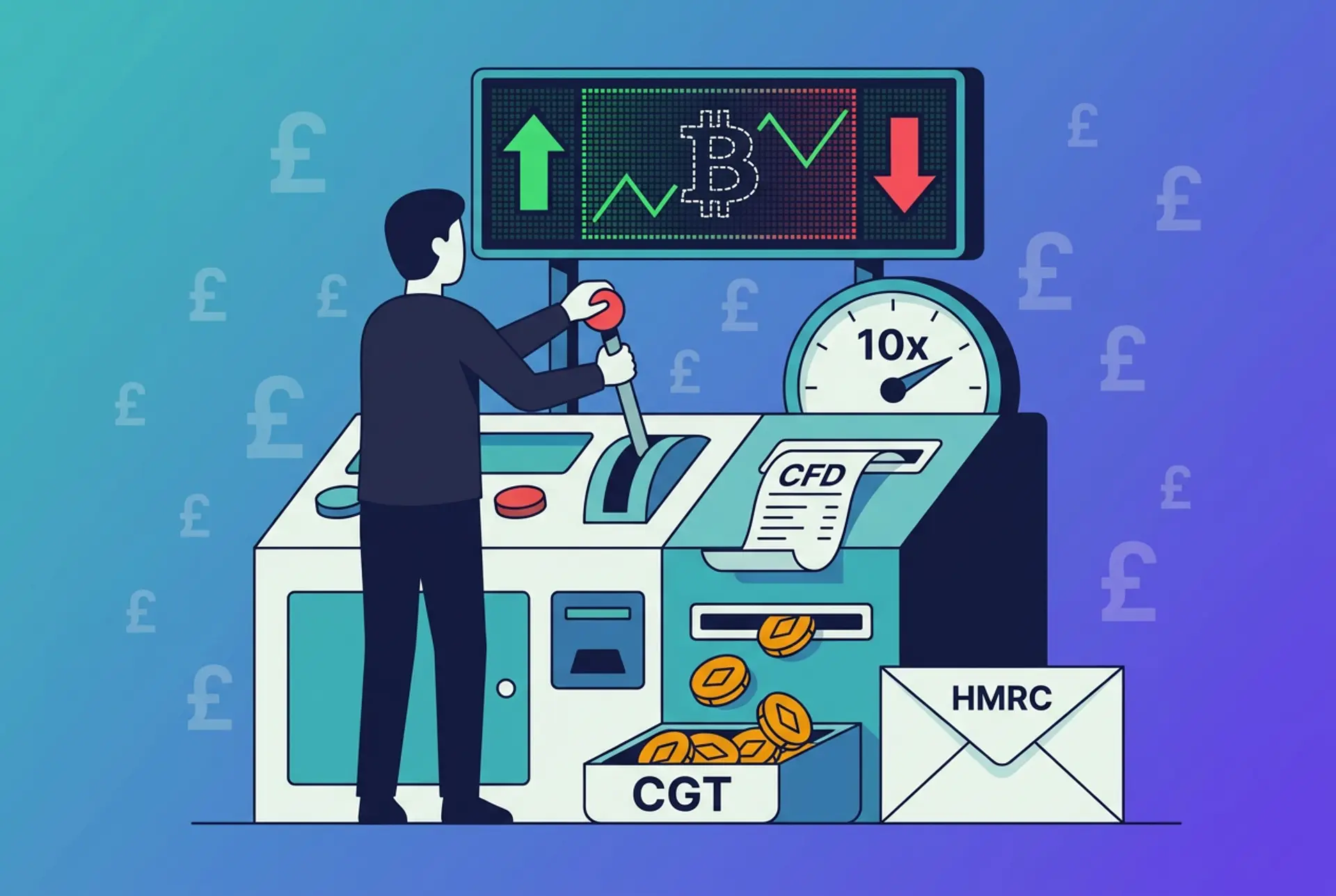
CFDs, or Contracts for Difference, are contracts where you speculate on the price movement of an asset (e.g., Bitcoin or Ethereum) without owning the asset itself.
- Going long: You profit if the price increases.
- Going short: You profit if the price decreases.
- Leverage: Borrowing funds to amplify potential gains (or losses).
Example: If Bitcoin rises 5% and you’ve used leverage, your profit could be 10% or more, but losses work the same way.
Futures contracts
A futures contract is an agreement to buy or sell an asset at a predetermined price on a future date.
- Use case: Hedging (reducing risk) or speculating on price movements.
- Settlement: Can involve actual delivery of the asset or cash payment based on price differences.
Example: Agreeing to buy Ethereum at £1,500 in three months. If Ethereum rises to £1,800, you profit £300 per unit.
Options
Options grant the right (but not the obligation) to buy (call) or sell (put) an asset at a fixed price within a specified timeframe.
- Call Option: Betting the price will increase.
- Put Option: Betting the price will decrease.
Example: Purchasing a call option to buy Bitcoin at £20,000 in 30 days. If Bitcoin hits £25,000, you can buy at the agreed price and profit.
Margin trading
Margin trading involves borrowing funds from a broker to trade larger amounts than your initial deposit.
- Potential Benefit: Higher profits due to larger position sizes.
- Risk: Amplified losses, as borrowed funds must be repaid even if the trade fails.
Example: With £1,000 and 10x leverage, you control £10,000. A 5% gain nets £500, but a 5% loss erases your £1,000 capital.
How are crypto derivatives taxed in the UK?
The tax position of trading and investing in derivatives over cryptoassets futures and margin trading is different to buying and selling cryptoassets.
“The nature of a derivative is typically very different to directly holding a cryptoasset. In particular, a derivative will give rise to contractual rights and obligations between the two parties. As a result, where a cryptoasset derivative has been entered into the guidance in this manual will not generally apply”.
HMRC, Cryptoasset Manual
HMRC refers individuals to their corporate finance manual for derivatives (non-crypto specific), which explores how trading profits, capital gains or miscellaneous income may apply.
Trading profits
Derivative contracts entered into for the purpose of a trade
If using derivatives to hedge interest rates or other risks; the profits or losses from those derivatives are included as trading profits.
Derivative contracts amounts to a trade
An individual might claim that their activity of trading in derivative contracts such as buying and selling CFDs or futures constitutes a trade arguing:
- Derivatives are more complex than shares, indicating a professional trading activity.
- Derivative assets, which don’t generate income (like dividends), are typically used for trading rather than holding.
HMRC's position - derivatives taxed as trading profits?
HMRC generally disagrees with the claim that trading derivatives is a trade or business, and will evaluate the claim based on the badges of trade and individual situation.
In most cases, HMRC deals with derivatives in the same way as it would buying and selling shares, so for most individuals, derivative trading will not meet the criteria for being a "trade."
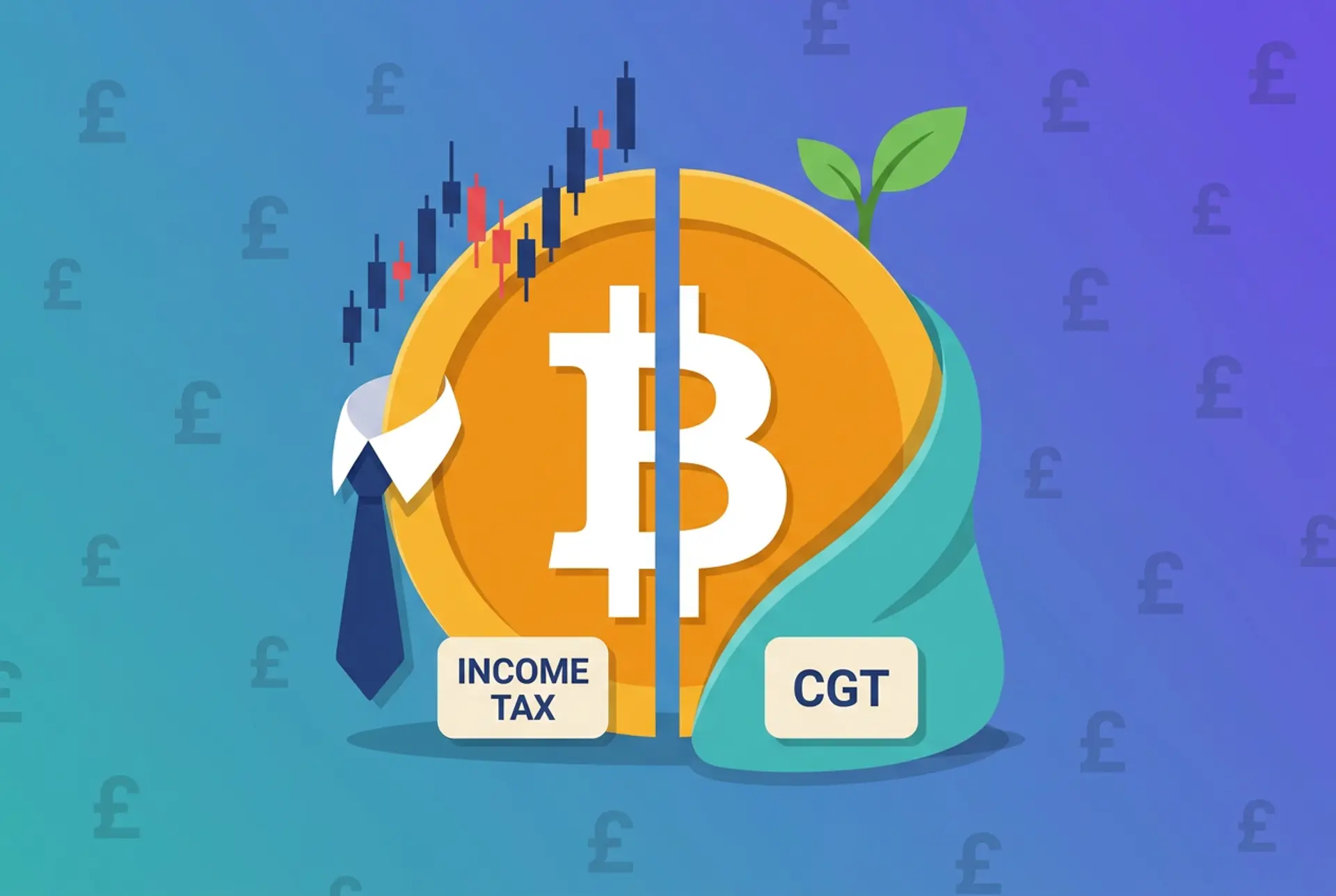
- If derivative trading does not qualify as a trade: profits or losses are taxed under capital gains tax (CGT) or as speculative income, depending on the circumstances.
- If derivative trading does qualify as a trade: profits or losses are treated as trading income, subject to income tax and possibly National Insurance contributions (NICs).
Take a look at our financial trader or crypto investor article or refer to our technical tax guide for more detail on HMRC's approach and the badges of trade.
Capital gains tax or miscellaneous income
Depending on circumstances, derivative profits may constitute miscellaneous income, or they may be taxable as capital gains. Normally miscellaneous income would take priority over capital gains, however tax legislation states that gains in the course of dealing in certain commodity or financial futures, traded options or financial options are charged as capital gains.
More information is available in our technical tax guide, but to reach the correct decision, we highly recommend getting help from a tax professional.
Can Recap’s tax software help with tax for crypto derivatives?
Accurate record-keeping of all historical transactions is essential for HMRC tax compliance, which is where Recap can make your life easier by helping you to track and automatically calculate your tax liability!
For CFDs, futures, and margin trading, it’s important to keep track of:
- Dates of opening and closing positions
- Contract values
- Profits or losses for each trade
- Fees and interest paid on leveraged trades
Our crypto tax calculator can simplify this process, helping you monitor your transactions and calculate your tax obligations with precision.