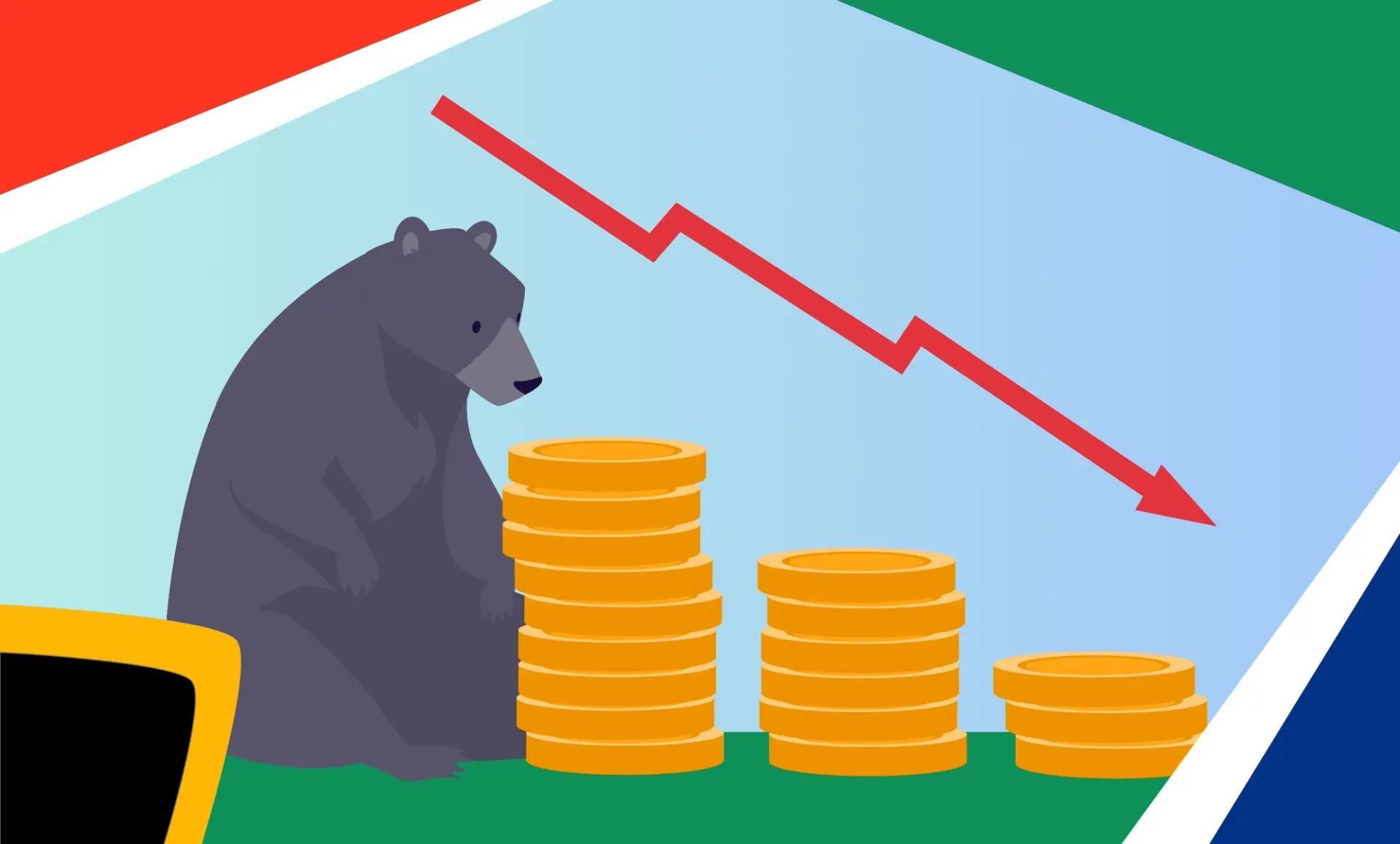

Due to the high market volatility and collapse of exchanges many investors have faced huge losses. The silver lining through all the bear market pain - you may be able to claim a loss to set you up for the next bull run.
Disclaimer
This guide is intended as a generic informative piece. This is not accounting or tax advice that can be relied upon for any UK individual’s specific circumstances. Please speak to a qualified tax advisor about your specific circumstances before acting upon any of the information in this article.
How can losses help South African crypto investors?
If you have realised losses on your cryptoassets then they can be used to offset capital gains and reduce your tax burden. If your losses in the tax year are higher than your gains then they can be carried forward to future tax years.
Calculating your crypto losses
To calculate the loss of an asset, you’ll need to work out the difference between the disposal price of the asset and the original acquisition cost. Sounds simple, but calculating your crypto taxes for the whole tax year solo can be complicated - you’ll need to establish fair market valuations for your assets, navigate SARS’ tax rules and work through all of your taxable transactions individually.
We suggest using crypto tax software to help crunch the numbers and determine your overall tax position. Simply connect your crypto accounts and Recap will work out your cost basis and total gains or losses for you automatically.
Further loss optimisation and tax strategies
You may be able to put some tax strategies like tax loss harvesting in place to optimise your tax bill even further.
Not tax advice
Disclaimer - this is not intended to be tax advice, seek help from a tax professional and ensure you fully understand the rules.
Tax Loss Harvesting
In crypto, tax loss harvesting is the process of selling a cryptoasset that has experienced a loss before the end of the tax year in order to offset gains, with the goal of minimising your tax liability.
If you're holding cryptoassets that are currently valued less than what you paid for them, it’s important to understand that they are a hypothetical loss and you haven’t realised the loss for tax purposes yet. To realise the loss you’ll need to dispose of the asset that has decreased in value, for example by selling it for fiat or trading it for another crypto. This loss can then be used to offset gains from other investments (beware of ring-fencing), effectively reducing your overall tax liability for the year.
Example
Let’s say you made a R50,000 gain on Bitcoin and have an unrealised R20,000 loss from Ethereum you are holding. By realising the loss, i.e. actually selling the underperforming Ethereum, you can offset it against your Bitcoin gains, bringing down your net gains to R30,000. This directly impacts the amount of tax you would owe for that tax year.
The bed and breakfast rule
In South Africa, there are general anti-avoidance rules (GAAR) in place to prevent taxpayers from engaging in artificial or contrived transactions to avoid paying tax. The GAAR can apply to a wide range of tax avoidance schemes, including those involving cryptoassets.
One common tax avoidance strategy is to dispose of a cryptoasset to realise a capital loss and lower the taxpayer's tax liability, and then buy the same asset back shortly thereafter. This is known as "bed and breakfasting." In South Africa, SARS has clear guidance on bed and breakfasting, stating that where the same asset is bought back within 45 days, the capital loss is disregarded and cannot be offset against gains.
Another tax avoidance strategy is to sell one cryptoasset for another to realise a capital loss and remain exposed to the market. For example, a taxpayer may trade Bitcoin for Wrapped Bitcoin, locking in a loss and then remaining exposed to the price of Bitcoin. However, it is important to note that the GAAR could potentially apply to this type of transaction, if it is found that the taxpayer's primary purpose was to avoid paying tax rather than to make a legitimate investment decision.
It is important for taxpayers to be mindful of the GAAR when considering any tax avoidance strategies involving cryptoassets. If a taxpayer is unsure whether a particular transaction is likely to fall foul of the GAAR, they should consult with a tax professional.
Writing off losses can dramatically reduce a taxpayer's tax bill, but it is a strategy that should only be used by those who can confidently navigate the tax rules and are comfortable with the risk and volatility of the crypto market.
Consult a tax professional
It is important to consult a tax professional to get personalised advice on how to best structure your crypto investments and tax planning.
Ring-fencing of losses: what you should know
When you make a loss, it may be; deducted from other income in the same tax year, carried forward to future tax year or ring-fenced and carried forwards to a future tax year. In South Africa, most losses can be used to offset income from different sources, however Section 20A of the Income Tax Act states that crypto losses should be ring-fenced. This means that you can not offset your crypto losses against other income types.
Crypto Losses
Essentially, you can only claim crypto losses against crypto income. You should note down your ring-fenced losses in the 'Additional Information' section to ensure SARS is aware.
Identifying the nature of your losses
Understanding whether you're a 'trader' or an 'investor' is your first task before tackling the ITR12 form. This distinction helps you pinpoint where and how to file your crypto asset losses on your tax return. Generally a trader has a far higher transactional frequency, whilst an investor must hold their crypto assets for an extended period of time, with no transactional movement.
Where a single asset is utilised both as an investment, and trading stock, an apportionment may take place for tax declaration purposes.
How to report losses from crypto on the ITR12
Once you understand your total losses you’ll need to report them on the ITR12. Whether your losses came from active trading or long-term investing, you'll need to report them in the correct sections:
- Trader: 'Local Business, Trade and Professional Income' using code 4201.
- Investor: 'Capital Gains' section using code 3115.
Here’s a step-by-step guide:
Reporting losses as a trader
- Log into SARS eFiling and find the ITR12 form.
- Navigate to the 'Local Business, Trade and Professional Income' section.
- Enter code 4201 to represent trading income or losses.
- Insert the amount of your loss.
- In 'Additional Information,' use code 4216 to specify your crypto trading losses.
Reporting losses as an investor
- Access your SARS eFiling account and open the ITR12 form.
- Head over to the 'Capital Gains' section.
- Use code 3115 to denote capital gains or losses.
- Record the amount of your capital loss.
- For ring-fenced losses, make a note under 'Additional Information.'
Important South African tax deadlines to keep in mind
For the 2023 filing season:
Non-provisional taxpayer deadline: 23rd October 2023.
Provisional taxpayer first provisional tax return deadline: 31st August 2023
Provisional taxpayer second provisional tax return deadline: 29th February 2024.
Final Words
Managing your crypto losses for tax purposes doesn't have to be overwhelming. With this guide, and Recap's crypto tax calculator you're well-equipped to tackle the ITR12 form this tax season. Should you find yourself in choppy waters, registered tax advisors like Crypto Tax Consulting are a great source for personalised advice. Good luck with your filing!
Disclaimer: The content in this blog is for informational purposes and is not financial or tax advice. Consult with a registered tax advisor for personalised guidance.